
CWDM vs DWDM: price difference of 10 times, what difference in performance?
author: Lawson
2025-08-01
1、 Price Gap
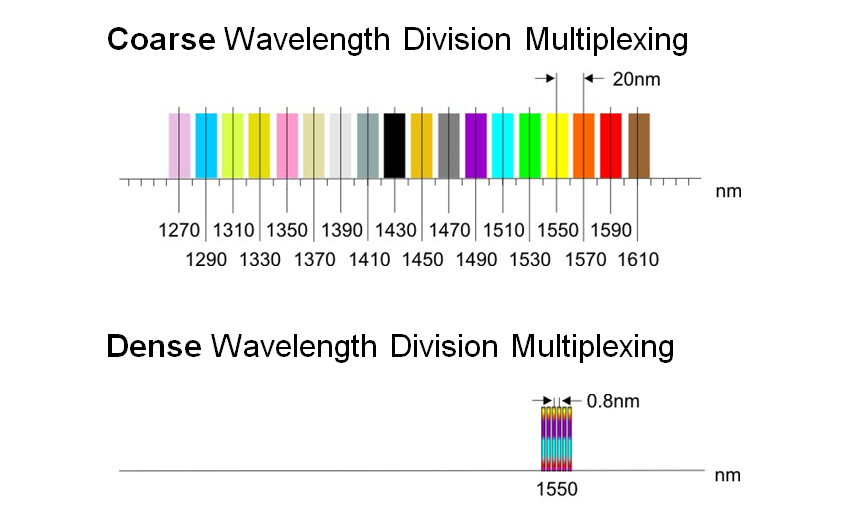
When enterprises plan to expand their optical networks, the price difference between coarse wavelength division multiplexing (CWDM) and dense wavelength division multiplexing (DWDM) is often staggering - under the same capacity, the cost of DWDM equipment can reach 4-5 times that of CWDM, and the price of optical modules can even differ by more than 10 times. This gap stems from the underlying differences in technological paths: CWDM uses a 20nm wide wavelength spacing, requiring only an uncooled laser and low-cost dielectric film filters; To achieve 80-160 channel multiplexing in narrow intervals of 0.4-0.8nm using DWDM, it is necessary to rely on precision temperature controlled lasers, high-precision gratings, or planar waveguide chips. Simply controlling the filter yield requires several times the cost.
When enterprises plan to expand their optical networks, the price difference between coarse wavelength division multiplexing (CWDM) and dense wavelength division multiplexing (DWDM) is often staggering - under the same capacity, the cost of DWDM equipment can reach 4-5 times that of CWDM, and the price of optical modules can even differ by more than 10 times. This gap stems from the underlying differences in technological paths: CWDM uses a 20nm wide wavelength spacing, requiring only an uncooled laser and low-cost dielectric film filters; To achieve 80-160 channel multiplexing in narrow intervals of 0.4-0.8nm using DWDM, it is necessary to rely on precision temperature controlled lasers, high-precision gratings, or planar waveguide chips. Simply controlling the filter yield requires several times the cost.
2、 Channel density
If we compare fiber optic bandwidth to land, CWDM is like building 8-18 independent villas on the 1270-1610nm spectrum, with each building spaced 20 nm apart; DWDM stacks 80 floors of apartments at 0.8nm intervals in the C-band of 1530-1565nm, and even extends to 160 floors through the L-band. This density difference directly determines the transmission capacity: a single fiber CWDM system can support up to 180Gbps, while DWDM can easily exceed 1.6Tbps. A data center case shows that after adopting 80 channel DWDM, the link that originally required 16 optical fibers was compressed to 1, reducing space occupation by 94% and power consumption by 60%.
3、 Transmission distance
Although the uncooled laser of CWDM is low-cost, its wavelength drift can reach ± 6.5nm, which limits its transmission distance to within 80 kilometers; DWDM controls drift within ± 0.1nm through TEC temperature control, and with EDFA optical amplifier, it can achieve cross ocean transmission. The measured data of a certain operator's backbone network shows that the signal-to-noise ratio (OSNR) of the DWDM system remains above 22dB during 2000 kilometers of transmission, while CWDM requires relay after 100 kilometers, and the comprehensive cost advantage is rapidly lost in long-distance scenarios.
4、 How to choose? Comparison of applicable scenarios
Choose CWDM if:
✅ Transmission distance < 80km
✅ Total bandwidth requirement < 200G
✅ Limited budget, pursuing high cost-effectiveness
✅ Poor environment (such as industrial, outdoor)
Choose DWDM if:
✅ Need for ultra long distance (>100km) or ultra large capacity (>1T)
✅ Possible upgrade to 100G/400G in the future
✅ Used for national backbone networks and submarine optical cables
✅ Need for ultra long distance (>100km) or ultra large capacity (>1T)
✅ Possible upgrade to 100G/400G in the future
✅ Used for national backbone networks and submarine optical cables
5. Conclusion
There is no absolute superiority or inferiority, only suitability. The technology of CWDM and DWDM is essentially a dynamic balance between cost, performance, and scenario requirements. Enterprises do not need to blindly pursue "high-end technology", but should focus on the essence of their business - in short distance, low capacity, and cost sensitive scenarios, ZG TECH's compact CWDM module provides reliable performance at a lower cost. Compared with ordinary standard CWDM MUX DEMUX modules, ZG TECH provides a compact CWDM MUX DEMUX module based on an optical platform (consisting of multiple filter collimators, substrates, and wedges), greatly reducing manufacturing costs and improving optical performance. In long-distance, high-capacity, and future scalable scenarios, DWDM or hybrid WDM is a more optimal solution. Technological iteration is endless, but suitable solutions are always the core of enhancing competitiveness.
Contact us immediately for customized optical network solutions!
WDM comparison, CWDM, DWDM, CCWDM What is the difference?
Related Article
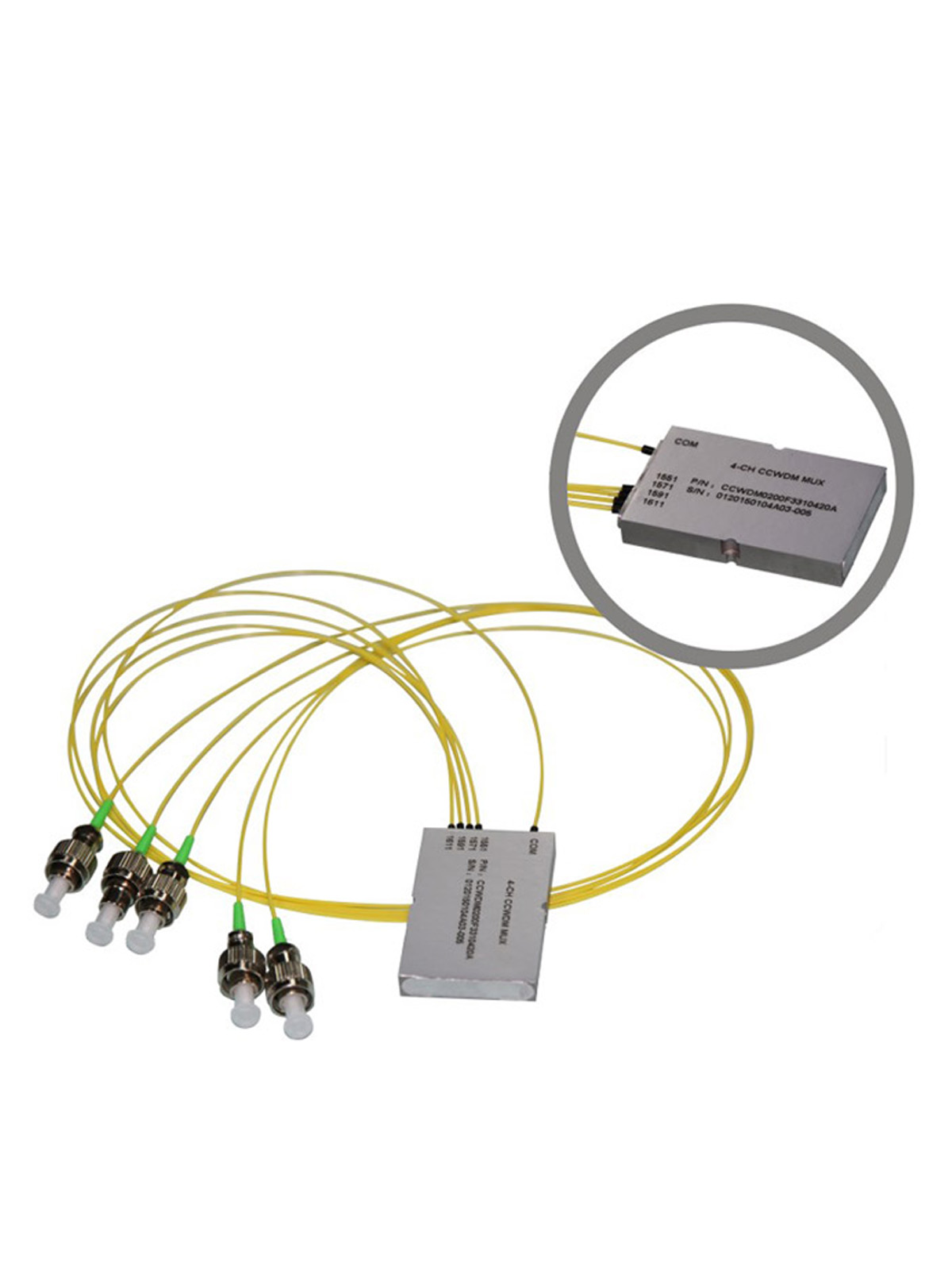
CCWDM is a mini-version of CWDM, a WDM based TFF technology that uses parallel beams to cascade signals of different wavelengths, and is 10 times smaller and less costly than CWDM. Wavelength division multiplexing technology has a broad application prospect in 5G communication and other fields
WDM comparison, CWDM, DWDM, CCWDM What is the difference?
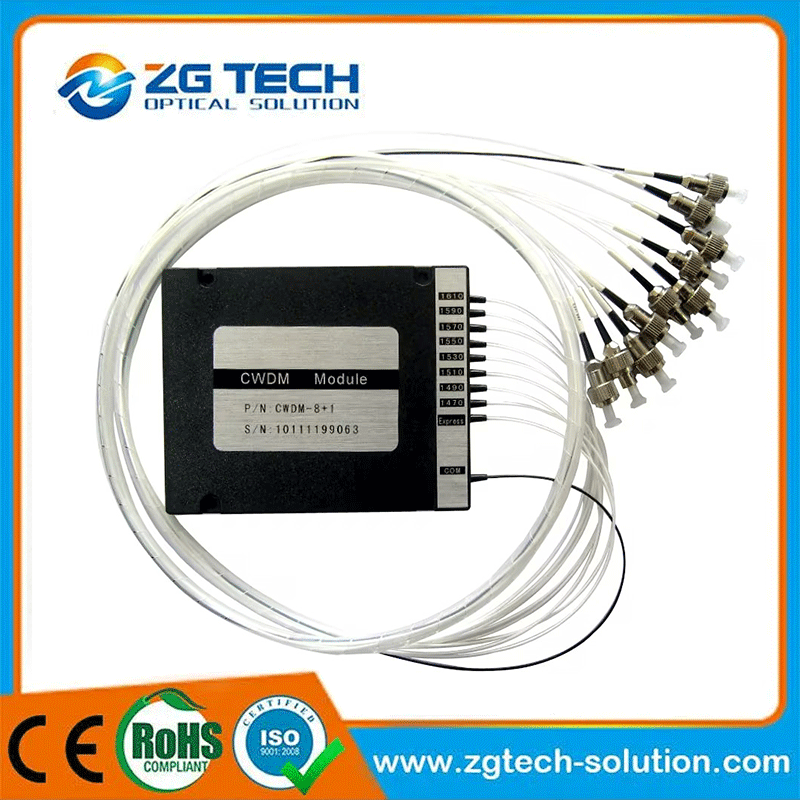
CWDM (Coarse Wavelength Division Multiplexing) is an optical fiber communication device that uses wavelength separation technology to combine multiple optical signals of different wavelengths into one fiber for transmission.It can merge multiple input ports into one output port to improve fiber utilization and transmission distance.
CWDM and how it works