
Optical circulator: Leading the technological innovation and future prospects in the field of optical communication
author: MM
2024-10-22
Optical circulator: Leading the technological innovation and future prospects in the field of optical communication

In the rapid development of optical communication technology, optical circulator, as a cutting-edge technological innovation, is gradually becoming a shining star in the industry. Its unique design concept and excellent performance not only promote the efficiency of optical communication systems, but also expand the application boundaries of optical technology. This article will deeply explore the unique charm of optical circulators from five aspects: the forefront of technological innovation, efficient cyclic transmission, wide application fields, excellent and stable performance, and future development prospects.

1. Frontier of technological innovation
As an outstanding representative of optical passive devices, optical circulators have set off a technological revolution in the field of optical communication with their multi-port input and output and non-reciprocal transmission characteristics. Traditional optical signal transmission methods are often limited by the limitations of a single path, while optical circulators, through innovative design, realize the orderly cyclic transmission of optical signals between multiple ports, greatly improving the flexibility and reliability of the system. It is particularly worth mentioning that in recent years, with the continuous advancement of micro-optical technology, optical circulators have become smaller in size and more integrated, further promoting their wide application in various optical communication systems.
2. Efficient cyclic transmission
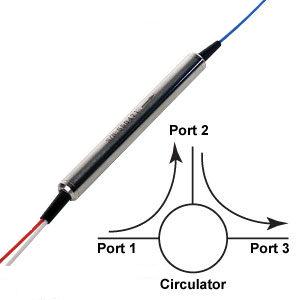
The core advantage of optical circulators lies in their efficient cyclic transmission capability. When an optical signal is input from a certain port, it can be output from the next port with minimal loss in a preset order, while the reverse transmission is effectively isolated. This unique transmission mechanism not only ensures the stable transmission of optical signals in the system, but also significantly reduces the crosstalk and loss between signals, and improves the transmission efficiency of the overall system. Especially in single-fiber bidirectional communication systems, optical circulators play an irreplaceable role, allowing one optical fiber to carry signal transmission in two directions at the same time, greatly saving optical fiber resources.
3. Wide application fields
The wide application field of optical circulators is an important manifestation of their technical value. In the field of optical communications, optical circulators are widely used in scenarios such as optical amplifiers, dense wavelength division multiplexing, optical time domain reflectometers (OTDRs) and bidirectional communication systems. In addition, in the fields of optical fiber sensing, optical fiber dispersion compensation and scientific research, optical circulators have also demonstrated their unique advantages. For example, in a fiber-optic sensing system, an optical circulator can guide the light input from the light source into the entire interference loop, and output the reflected light from another port for photoelectric conversion and data acquisition, providing a strong guarantee for the stable operation of the sensing system.
### 4. Excellent and stable performance
The optical circulator also performs well in performance. Its high isolation, low insertion loss, high return loss and high stability enable it to maintain stable transmission performance in various complex optical communication environments. In particular, with the continuous introduction of high-end products such as polarization-maintaining optical circulators, the performance of optical circulators has been significantly improved. These high-performance optical circulators can not only meet various high-precision and high-demand optical communication needs, but also provide a solid guarantee for the long-term stable operation of optical communication systems.
5. Future development prospects
Looking to the future, the development prospects of optical circulators are broad. With the rapid development of new-generation information technologies such as 5G and the Internet of Things, the demand for optical communication systems will continue to grow. As one of the key components in optical communication systems, the market demand for optical circulators will also continue to expand. At the same time, with the continuous advancement of micro-optical technology and the continuous reduction of costs, the production cost of optical circulators will be further reduced, allowing them to be more widely used in various optical communication systems. In addition, with the in-depth research and innovation of researchers on optical circulator technology, more new optical circulator products with better performance and more complete functions will emerge in the future, injecting new vitality into the development of the optical communication field.
In summary, as the forefront of technological innovation in the field of optical communication and a model of efficient cyclic transmission, optical circulators are leading the future development of optical communication technology with their excellent performance and wide application fields. We have reason to believe that in the days to come, optical circulators will continue to play their unique advantages and contribute more to the prosperity and development of the optical communication field.
Fiber Collimator: Precision Light in the Information Age
What is Optical Circulator?
Related Article

With the rapid development of science and technology, optical fiber technology has become the core pillar of modern communication, data acquisition and precision measurement. As a key component in optical fiber technology, optical fiber collimator is playing an irreplaceable role in many fields with its unique functions and excellent performance.
Fiber Collimator: Precision Light in the Information Age
Fiber optic ring coupler, also known as fiber optic ring resonator, is a device that allows the transfer of light from one fiber optic cable to another in a circular path. It typically consists of a ring-shaped loop of optical fiber that is coupled to an input and output fiber. When a light signal is input into the loop, it circulates around the loop and is coupled to the output fiber.
What is Optical Circulator?
