Hollow core fiber: a technological revolution for reconstructing the future of optical communication
author: Lawson
2025-10-21
1、 Introduction: Breaking the traditional emerging fiber optic technology
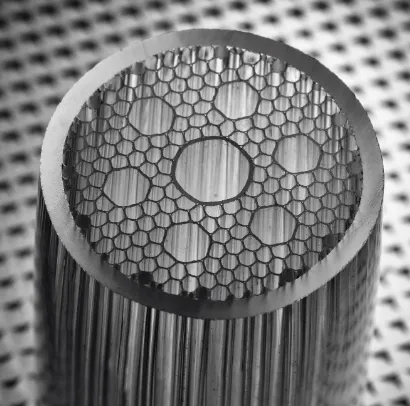
Hollow Core Fiber (HCF) is a revolutionary innovation in the field of optical communication, which subverts the traditional mode of solid core fiber that relies on total reflection principle to guide light. Unlike traditional optical fibers that use solid materials such as quartz as optical transmission media, the core area of hollow core optical fibers is air or vacuum, and light waves are confined to propagate in the air core through a specially designed cladding structure. This unique structure demonstrates significant advantages in transmission performance and has become a key technology to solve the current bottleneck of optical communication capacity and reduce transmission latency. It is gradually moving from the laboratory to industrial applications.
Hollow Core Fiber (HCF) is a revolutionary innovation in the field of optical communication, which subverts the traditional mode of solid core fiber that relies on total reflection principle to guide light. Unlike traditional optical fibers that use solid materials such as quartz as optical transmission media, the core area of hollow core optical fibers is air or vacuum, and light waves are confined to propagate in the air core through a specially designed cladding structure. This unique structure demonstrates significant advantages in transmission performance and has become a key technology to solve the current bottleneck of optical communication capacity and reduce transmission latency. It is gradually moving from the laboratory to industrial applications.
2、 Working principle: Cleverly using structural constraints to constrain light waves
Hollow fiber optics mainly achieve efficient transmission of light in an air core through two physical mechanisms:
Photon bandgap effect (PBG)
The cladding is composed of periodically arranged microporous structures, forming a photonic crystal. This periodic structure generates a photonic bandgap within a specific wavelength range, acting as an "optical filter" that prevents photons within the bandgap from leaking into the cladding, thereby limiting the propagation of light waves within the air core. For example, the nested hollow core fiber (NANF) developed by the University of Southampton achieves low loss transmission of 0.28dB/km at a wavelength of 1510nm through a multi-layered nested microporous structure in its cladding, effectively constraining light waves using the photonic bandgap effect.
Anti resonance effect (ARF)
The cladding is composed of thin-walled glass tubes arranged in a specific geometric shape. When light waves propagate in the fiber core, the core mode and the cladding ring resonance mode are in an anti resonant state. At this time, the energy of the light waves is mainly concentrated in the air core, and the absorption and scattering losses of the cladding on the light waves are minimal. The double-layer nested anti resonant knotless fiber (DNANF) developed by Lumensity, a subsidiary of Microsoft, set a world record of 0.091dB/km in the 1550nm band, which is a typical case of successful application of anti resonant effect.
3、 Benefit: Comprehensive performance improvement
Ultra low transmission latency
Due to the fact that the propagation speed of light in air is close to the speed of light in vacuum (about 3 × 10 ⁸ m/s), the propagation speed of light in traditional quartz fibers is significantly reduced due to the influence of material refractive index (about 2 × 10 ⁸ m/s). Therefore, the transmission time delay of hollow core optical fibers is reduced by about 30% compared to traditional optical fibers. In the scenario of data center interconnection, the use of hollow fiber optic cables can reduce the data synchronization delay between AI training clusters from 200 μ s to 140 μ s, greatly improving the real-time performance of distributed computing.
Extremely low nonlinear effects
Traditional quartz fiber can cause signal distortion during high-power optical signal transmission due to the nonlinear characteristics of the material, such as self phase modulation and cross phase modulation. In hollow core optical fibers, light mainly propagates in the air core, and the nonlinear coefficient of air is extremely low (about 10 ⁻¹⁹ (W · m) ⁻¹), which is four orders of magnitude lower than traditional quartz fibers (about 10 ⁻¹⁵ (W · m) ⁻¹). This enables hollow core optical fibers to carry higher power optical signals without significant nonlinear distortion, which has significant advantages in high-power laser transmission and long-distance optical communication.
Wide working bandwidth
The working bandwidth of traditional quartz fiber is mainly concentrated in the C-band (1530-1565nm) and L-band (1565-1625nm), with a bandwidth of about 150nm. The working bandwidth of hollow core fiber can cover the O-U band (1260-1675nm), exceeding 1000nm, which is seven times that of traditional fiber. This provides richer spectrum resources for optical communication systems, supporting higher data transmission rates.
4、 Application: Showcasing Strong Potential in Multiple Fields
Data Center Interconnection
With the rapid development of technologies such as artificial intelligence and big data, the amount of data transmission between data centers is exploding. The ultra-low latency and ultra large capacity characteristics of hollow fiber make it an ideal choice for data center interconnection. The world's first commercial trial network of hollow fiber optic cables built by China Mobile in Ningxia has achieved 246 picometers of relay free transmission with a system capacity of 1.2Tbps, effectively meeting the real-time transmission needs of massive data between data centers.
High power laser transmission
In the field of industrial manufacturing, such as laser cutting, welding, etc., high-power lasers need to be transmitted. The high laser damage threshold and low loss characteristics of hollow core fibers enable stable transmission of high-power lasers, improving processing quality and efficiency. For example, in automobile manufacturing, using hollow fiber optic transmission laser for body welding can increase welding speed by 30% and ensure more stable welding quality.
quantum communication
Quantum communication has strict requirements for the signal-to-noise ratio and transmission distance of the transmission medium. The ultra-low nonlinearity of hollow core optical fibers can effectively reduce the noise interference of quantum signals and improve the signal-to-noise ratio. Meanwhile, its wide operating bandwidth provides more available channels for quantum key distribution (QKD), enabling transmission distances to exceed 500km and laying the foundation for the practical application of quantum communication.
5、 Challenge: Key obstacles to widespread application
High manufacturing process complexity
The manufacturing of hollow core optical fibers involves multiple complex process steps, such as the preparation of high-purity quartz preforms, precision microstructure forming, and low-temperature drawing. Among them, precision forming of microstructures requires stacking hundreds of thin-walled capillaries in a specific geometric arrangement to form a honeycomb like cladding structure, with extremely high requirements for dimensional control accuracy (up to ± 0.1 μ m). At present, the yield rate in the manufacturing process still needs to be improved, which increases production costs.
Difficulty in performance optimization
Although significant progress has been made in attenuation coefficient and nonlinear effects of hollow core fibers, further optimization is still needed. For example, in terms of gas absorption control, the absorption of hydroxide ions in the 1310nm band will result in additional losses, which need to be reduced from 0.5dB/km to 0.05dB/km through techniques such as helium replacement. In addition, issues such as polarization mode dispersion (PMD) and mode to mode interference can also affect the quality of signal transmission, requiring the development of more advanced structural designs to suppress them.
The standardization system is not perfect
At present, the standardization process of hollow core optical fibers is still in its infancy. Although ITU-T has initiated the development of the G.658.3 hollow fiber standard, further improvement is needed in the unified specification of key indicators such as attenuation coefficient, macro bending loss, and temperature stability. The lack of unified standards can lead to compatibility and interchangeability issues with hollow core optical fibers produced by different manufacturers, which hinders the large-scale development of the industry.
High costs remain high
Due to the complex manufacturing process, high raw material requirements, and small production scale, the cost of hollow core optical fibers is much higher than that of traditional quartz optical fibers. At present, the market price of hollow fiber is several times or even tens of times higher than that of traditional fiber, which to some extent limits its large-scale commercial application. How to reduce production costs and improve product cost-effectiveness is an important challenge facing the hollow fiber optic industry.
Looking ahead to the future, hollow fiber optics will be deeply integrated with silicon optical chips and AI algorithms to build an integrated network of "light computing perception". According to market research institutions' predictions, the global market size of hollow fiber optic cables will reach 105 million US dollars by 2030, with a compound annual growth rate of over 20%. With continuous innovation in materials science (such as sulfide glass) and manufacturing processes (such as 3D printed preforms), this "speed of light channel in the air" will ultimately reshape the underlying logic of the human information society.
20 Questions on Basic Knowledge of Fiber Optic Cables
Global Optical Communication Industry Trends in 2025: Innovations, Market Shifts, and Key Players