
Common problems with Fiber Bragg Grating (FBG)
author: Jocelin
2024-12-27
Fiber Bragg Grating (FBG) sensor is a new type of fiber optic sensor developed in recent years. The basic principle is to create a grating region with a refractive index periodic distribution at a specific position of the optical fiber, where light waves of a specific wavelength (Bragg reflection light) will be reflected. The reflected central wavelength signal is related to the grating period and the effective refractive index of the fiber core.

Figure 1. FBG structure
Using the grating area as a sensing area, when the temperature, structure, or position of the sensed substance changes, the period of the grating and the effective refractive index of the fiber core mode will change accordingly, thereby changing the Bragg center wavelength. By using a spectral analyzer or other wavelength demodulation techniques to detect the Bragg wavelength of reflected light, the changes in the measured parameter can be obtained.

Figure 2. Working principle of FBG
Characteristics of Fiber Bragg Grating Sensor
Bragg fiber Bragg grating can be used as a type of fiber optic sensor, which, like fiber optic sensors, has many irreplaceable advantages compared to traditional electrical sensors, such as no electromagnetic interference, light weight, small size, and no corrosion. In addition, due to its wavelength encoding, it has many advantages compared to traditional fiber optic sensors, such as accuracy not affected by light source intensity, less affected by the environment, easier reuse, and distributed sensing.

Figure 3. FBG sensing system structure
By utilizing the advantages of strong multiplexing capability, light weight, and small size of fiber Bragg grating sensing systems, embedded in monitoring materials, quasi distributed measurements can be easily achieved, making it the most promising intelligent sensing network technology.
Characteristics of FBG technology
1. High measurement accuracy - FBG stress measurement accuracy can reach 1 μ ε, and temperature measurement accuracy can reach 0.1 ℃
2. Short response time - the response time of a single FBG sensor is less than 0.01s (the time is related to the actual distance between the FBG sensor and the monitor)
3.Large measurement range - strain measurement can exceed 10000 μ ε
What are the applications of fiber Bragg grating sensors?
1.Civil Engineering
Structural monitoring in civil engineering is a hot topic in the application of fiber Bragg grating sensors. Real time and safe temperature and strain monitoring can be carried out in projects such as bridges, buildings, offshore oil platforms, oil fields, aviation, and dams.
The measurement of the state and mechanical parameters of the infrastructure is crucial for the maintenance of bridges, dams, tunnels, high-rise buildings, and sports venues. By measuring the distributed strain of buildings, the state of local loads can be predicted. Fiber Bragg grating sensors can be attached to the surface of existing structures or embedded in structures during pouring to measure and monitor the formation and growth of structural defects in real time.
In addition, multiple fiber Bragg grating sensors can be connected in series to form a network for quasi distributed detection of the structure, and the sensing signals can be transmitted over long distances to the central monitoring room for telemetry. Therefore, in civil engineering, fiber Bragg grating sensors have become the most important means of structural monitoring.
2.AEROSPACE
Aerospace is a sensor intensive field, and an aircraft requires over 100 sensors to monitor pressure, temperature, vibration, fuel level, landing gear status, wing and rudder position, etc. Therefore, the size and weight of sensors become very important.
Fiber optic grating sensors have the advantages of small size, light weight, and high sensitivity. By embedding fiber optic gratings into aircraft or transmission tower structures, a quasi distributed intelligent sensing network can be formed, which can monitor the internal mechanical performance and external environment of the aircraft and transmission tower in real time.
3.Modern ships
Bragg fiber Bragg grating sensors can provide instantaneous and rich sensing information for the operation of modern ships, thereby ensuring the safety of ships by providing early hazard warnings and damage assessments required by ship operators.
Up to 90% of modern marine sensors are pressure or temperature sensors. By selecting appropriate packaging and substrate materials, fiber Bragg grating strain sensors can be transformed into temperature and pressure sensors. Using the principles of wavelength division and time-division multiplexing, a detection system can have up to tens of thousands of fiber Bragg grating sensors, which can adapt to the increasing complexity of shipborne control systems and effectively reduce the cost of sensing systems.
4.Electric power industry
Most equipment in the power industry is located in strong electromagnetic fields, and general electrical sensors cannot be used. In many cases, the places that need to be measured are located in high voltage, such as online monitoring of high voltage switches, real-time measurement of temperature and displacement parameters of high voltage transformer windings, generator stators, etc. These measurements require sensors with good insulation performance, small size, and passive components. Fiber Bragg grating sensors are the best choice for these measurements.
In addition, some power equipment is often located in hard to reach areas, such as transmission cables and relay substations in barren mountains and deserts. The telemetry capability of quasi distributed fiber Bragg grating sensing systems can greatly reduce equipment maintenance costs. Therefore, the application prospects of fiber Bragg grating sensors in the power industry are very promising.
5.Medicine
Small size sensors are very meaningful in medical applications, and fiber Bragg grating sensors are currently the smallest fiber optic sensors that can be achieved. Fiber Bragg grating sensors can measure the internal functions of human tissue with minimal invasion, providing accurate local information about temperature, pressure, and acoustic fields. Fiber Bragg grating sensors cause minimal damage to human tissues, which is sufficient to avoid interference with normal medical processes.
6.Nuclear industry
The nuclear industry has high radiation levels, and nuclear leaks pose a great threat to humanity. Therefore, safety inspections of nuclear power plants are very important. Due to the aging of nuclear facilities, more maintenance and repair are required, and ultimately they must be dismantled, all of which cannot be foreseen during design. Therefore, more sensors are needed for remote control of equipment and handling uncertain situations.
At the same time, the management of nuclear waste has become increasingly important, requiring a monitoring network to monitor the condition of nuclear waste stations. The demand for long-term stability of the monitoring network is unprecedented, and fiber Bragg grating sensing networks can meet these requirements.
7. Photo-communication
The main application of fiber Bragg gratings is in optical communication systems, specifically used as notch filters, and can also be used in optical multiplexers and demulsifiers, as well as optical circulators or optical add/drop multiplexers (OADMs).
Impact four channels (represented as four colors) of FBG through an optical cycler. FBG is set to reflect one of the channels, which is channel 4. The signal is reflected back into the loop, directed downwards in the loop, and discarded from the system. Due to the channel being disconnected, another signal on that channel can be added at the same point in the network.
A multiplexer can be implemented by cascading multiple split parts of OADM, where each split element uses an FBG set to the wavelength to be multiplexed. On the contrary, a multiplexer can be implemented by cascading multiple additional parts of OADM. FBG demultiplexer and OADM are also adjustable. In a tunable multiplexer or OADM, the Bragg wavelength of FBG can be tuned by the strain applied by a piezoelectric sensor.
FBT Fused Coupler: Key Technology and Applications in Fiber Optic Communication
Optical Passive Devices: The Key Cornerstones in Optical Communication
Related Article

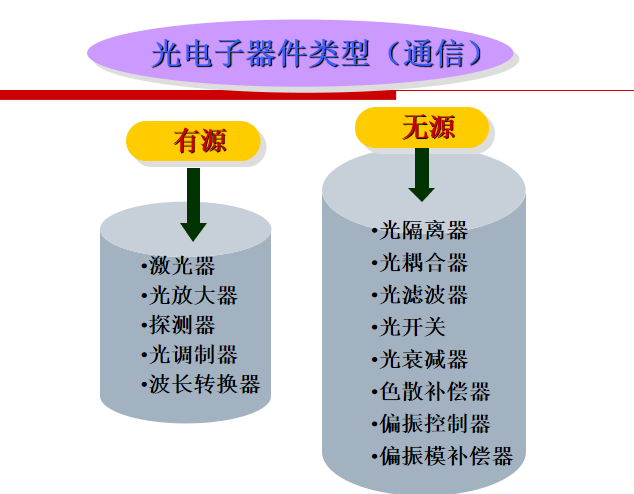
The article comprehensively presents the crucial types, characteristics, testing, applications, and development prospects of optical passive devices in optical communication, highlighting their indispensability and importance in the field.
Optical Passive Devices: The Key Cornerstones in Optical Communication