
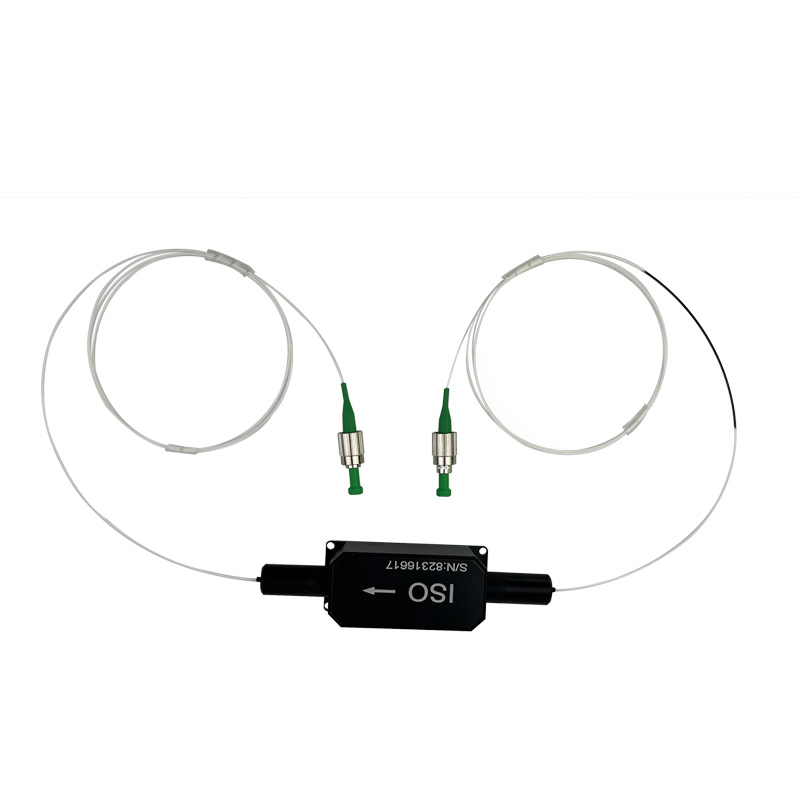
Fiber optic isolator: the "one-way valve" for optical communication
In modern optical communication systems, the echo reflection of optical signals can cause serious problems. The reflected light at the fiber optic connection end face and device interface may cause a decrease in laser performance, an increase in system noise, and even damage to expensive light source equipment. Fiber optic isolators are like "one-way valves" in the optical path, specifically designed to ensure that optical signals can only be transmitted in one direction, effectively blocking interference from reverse light.
The necessity of optical isolation
Reverse reflection light poses significant risks in systems such as optical communication, laser processing, and fiber optic sensing. It can cause unstable operation of the laser, resulting in wavelength drift and mode jitter, seriously affecting communication quality. Meanwhile, the reflected light will interfere with the original signal, significantly increasing system noise. The most dangerous thing is that in high-power laser systems, the echo may directly burn out the laser diode, causing significant losses.
The core principle and structural characteristics of fiber optic isolators
Fiber optic isolators achieve unidirectional transmission of optical signals based on Faraday magneto-optical effect. The core working principle is that when linearly polarized light passes through magneto-optical materials such as yttrium iron garnet (YIG), the polarization direction will rotate 45 ° under the action of a magnetic field. This rotation has the characteristic of non reciprocity, which means that when the reflected light returns, the polarization direction will continue to rotate in the same direction by 45 °, and eventually be blocked by a difference of 90 ° from the incident light. A typical fiber optic isolator consists of three key components: the input polarizer is responsible for converting incident light into linearly polarized light, the Faraday rotator achieves precise rotation of the polarization plane, and the output polarizer selectively allows forward light to pass through while blocking reverse light. This sophisticated structural design endows the isolator with three core characteristics: ensuring non reciprocity in unidirectional transmission, low insertion loss typically less than 1dB, and high isolation of 30-50dB.
Diversified application scenarios and performance requirements
Fiber optic isolators play a crucial role in multiple fields, and different application scenarios require differentiated performance. In optical communication systems, it mainly protects DFB/FP lasers from reflected light damage and avoids reverse interference of spontaneous emission light in EDFA amplifiers; The industrial laser field requires isolators to block high-power lasers reflected by materials, while medical equipment relies on them to ensure stable output of therapeutic lasers; In the field of scientific research, fiber optic gyroscopes use it to reduce backscatter noise, while quantum communication systems use it to protect sensitive single photon detectors. These application scenarios impose strict requirements on the performance parameters of isolators, including key indicators such as wavelength matching, power tolerance, polarization related losses, etc. When selecting, comprehensive considerations should be made based on specific application scenarios.
Conclusion
Although compact in size, fiber optic isolators are indispensable "invisible guardians" in modern optical systems. From 5G communication to industrial lasers, it silently ensures the purity and stability of optical signals, providing reliable guarantees for various optical applications. When choosing a fiber optic isolator, it is necessary to comprehensively consider parameters such as operating wavelength and power tolerance. Welcome to consult our professional technicians to choose the most suitable product model based on specific application scenarios, ensuring the best performance of the system.
Optical Isolators: The Invisible Force Driving Global Technological Transformation
Cannot be ignored optical isolator: improving the quality of optical signals
Related Article
