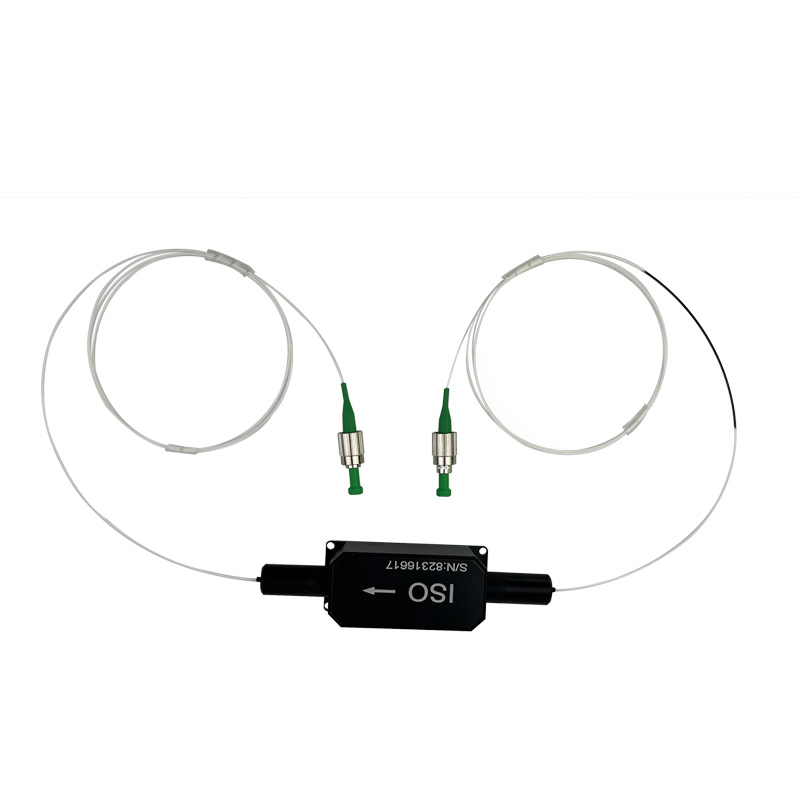
Optical Isolators: The Invisible Force Driving Global Technological Transformation
Optical Isolators: The Invisible Force Driving Global Technological Transformation
July 21, 2025, Global — Optical isolators, once a term only mentioned in specialized fields, are now capturing widespread attention in the global technology industry due to their groundbreaking advancements. From communication networks to medical devices, from industrial manufacturing to consumer electronics, the applications of optical isolators are quietly transforming our world. This article will provide a comprehensive understanding of this global technological revolution by exploring its technical principles, application scenarios, and future prospects.
I. Working Principles and Technological Breakthroughs of Optical Isolators
1. What is an Optical Isolator?
An optical isolator is an optical device primarily used to prevent the reflection of light signals during transmission, ensuring signal stability and reliability. Its core function is to allow light to pass in one direction while blocking reverse light propagation. This feature is crucial in fiber optic communications, laser systems, and optical measurements.
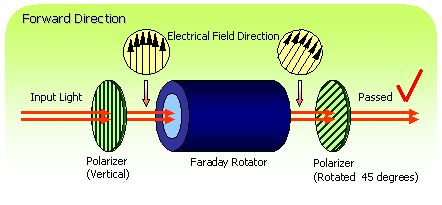
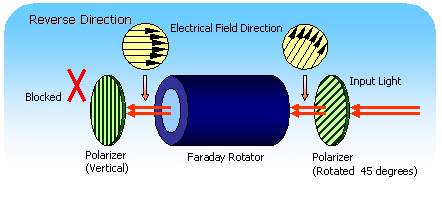
a.Working Principle of Optical Isolator
2. Core Technological Breakthroughs
In recent years, global research institutions have achieved several significant breakthroughs in optical isolator technology:
- New Materials: The joint development of topological photonic crystal materials by MIT and the Max Planck Institute has expanded the working bandwidth of optical isolators to the 1500-1700nm range, significantly reducing insertion loss.
- Manufacturing Processes: The pioneering atomic layer deposition (ALD) 3D integration technology by the University of Tokyo has enabled the monolithic integration of optical isolators with silicon photonic chips, greatly reducing device size.
- Intelligent Control: The programmable optical isolator platform developed by the University of California, Berkeley, has achieved dynamic isolation ratio adjustment for the first time, providing adaptive optical path protection for 5G/6G networks.
II. Global Application Scenarios of Optical Isolators
1. Upgrading Communication Infrastructure
Optical isolators play a vital role in fiber optic communication systems. With the global rollout of 5G networks and the development of 6G technology, communication networks demand higher stability and efficiency in light signal transmission. The application of new optical isolators has significantly enhanced the performance of fiber optic networks, reducing signal attenuation and interference, and providing users with faster and more stable network experiences.
2. Revolutionizing Medical Devices
In the medical field, optical isolators are driving advancements in precision medicine. Medtronic's latest surgical robots integrate miniature optical isolator components, improving laser surgery positioning accuracy to the 10-micron level. Siemens Healthineers' OCT imaging systems use novel polarization-independent isolators, achieving retinal scan resolutions of 5μm, offering more precise tools for ophthalmic diagnostics.
3. Transforming Advanced Manufacturing
In the industrial sector, optical isolators are widely used in laser processing, precision measurement, and automated control. TRUMPF Group's industrial lasers, equipped with high-temperature-resistant optical isolators, have extended the continuous operation time of kilowatt-level fiber lasers by three times. ASML's EUV lithography machines use specialized magneto-optical isolators to effectively suppress light source reflection interference, improving chip yield.
III. Future Prospects of Optical Isolators
1. Technological Evolution Directions
Over the next five years, optical isolator technology will evolve in the following directions:
- Biointegration: Biodegradable optical isolators for implantable medical devices, advancing biomedical engineering.
- Quantum Compatibility: Ultra-low-noise devices meeting the requirements of quantum communication networks, supporting next-generation communication technologies.
- Self-Powered Design: Smart isolators utilizing photothermal effects for energy self-sufficiency, promoting green energy technology applications.
2. Market Outlook
According to the latest report by Yole Développement, the global optical isolator market is expected to surpass $12B by 2028, with a compound annual growth rate (CAGR) of 34.7%. Regions such as North America, Europe, and Japan/Korea will continue to lead technological innovation and industrial applications, fostering a globally coordinated development landscape.
3. Ethical and Standardization Challenges
As optical isolator technology rapidly advances, ethical and standardization debates have emerged. The International Society for Optics and Photonics (SPIE) has established a task force to develop a globally unified technology roadmap, balancing innovation competition with industrial collaboration.
IV. Conclusion: The Visible Impact of Invisible Technology
The evolution of optical isolators confirms a technological truth: breakthroughs in fundamental components can drive industry transformations far beyond expectations. As this technology gradually transitions from specialized equipment to consumer terminals, its influence will extend beyond communication, ultimately changing the basic modes of human-computer interaction. As Nobel laureate Donna Strickland stated, "The optical revolution of the 21st century is being driven by innovations on the microscopic scale."
Looking Ahead, optical isolator technology will continue to drive global technological transformations, bringing new possibilities to communication, healthcare, industry, and beyond. With ongoing advancements and expanding applications, optical isolators will become a cornerstone of an intelligent society, promoting sustainable development worldwide.
Fiber optic isolator: the "one-way valve" for optical communication
Related Article