What are SC, LC, ST, FC fiber optic connectors?
SC, LC, ST, and FC fiber optic connectors are the core components for achieving detachable fiber optic connections in fiber optic communication systems. They ensure efficient transmission of optical signals by precisely docking the fiber end faces, while also adapting to the needs of different scenarios. The following is a detailed introduction to these four types of connectors:
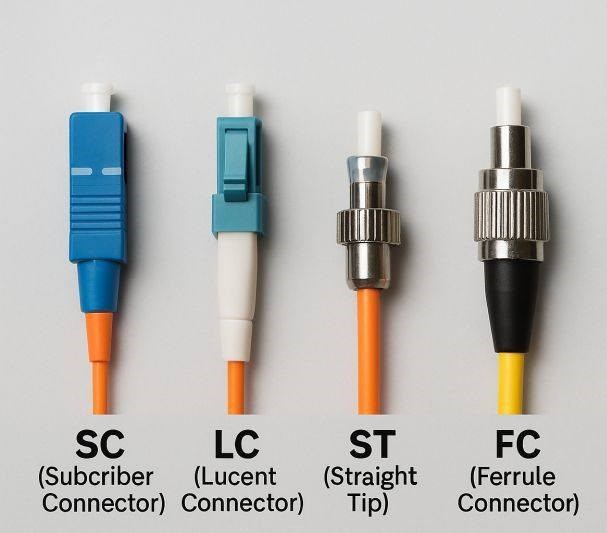
SC, Abbreviation for Square Connector or Standard Connector.
The SC fiber optic connector is developed by NTT Corporation in Japan, with a rectangular housing and a plug-in pin bolt fastening method. Its direct insertion design does not require rotation operation, and with the rotation locking mechanism, it ensures connection firmness and improves insertion and removal efficiency. The internal ceramic sleeve component ensures precise alignment of the optical fiber, reduces signal loss, and is compatible with both single-mode and multi-mode optical fibers. SC connectors are commonly used in data center networks, fiber to the home (FTTH), and server connections, making them an ideal choice for balancing performance and usability.
LC, Abbreviation for Lucent Connector
The LC fiber optic connector was developed by Lucent Technologies and uses a 1.25mm ceramic plug, which is only half the volume of traditional connectors and belongs to the miniaturization (SFF) design. Its modular jack and RJ latch mechanism make the plugging operation intuitive and convenient, especially suitable for high-density wiring environments. With high-precision alignment technology, LC connectors can achieve a typical insertion loss of ≤ 0.15dB and are compatible with single-mode and multi-mode fibers. They are widely used in high-speed transmission scenarios such as data centers, communication networks, and medical equipment.
ST, Abbreviation for straight Tip
The ST fiber optic connector is launched by AT&T and features a bayonet locking mechanism and a circular housing design. Insert and rotate half a circle to lock, easy to operate; Sintering technology ensures product stability, but the physical structure is relatively fragile. ST connectors are widely used in short distance, low-speed scenarios such as optical distribution frames (ODFs), 10Base-F networks, and instrumentation due to their low-cost advantage, making them an economical choice in budget limited scenarios.
FC, Abbreviation for Ferrule Connector
The FC fiber optic connector is also developed by NTT Corporation, using a metal sleeve reinforced structure and threaded screw fastening method. Its threaded fixation design provides high stability and is suitable for scenarios that require frequent maintenance; The deformation of the metal sleeve is small within the range of -40 ℃ to+85 ℃, ensuring long-term performance stability; IP67 protection level can withstand harsh environments. FC connectors are commonly used in the fiber optic distribution frame (ODF) of telecommunications networks, long-distance communication, and industrial control fields, especially suitable for scenarios with strict stability requirements.
The difference between APC and UPC
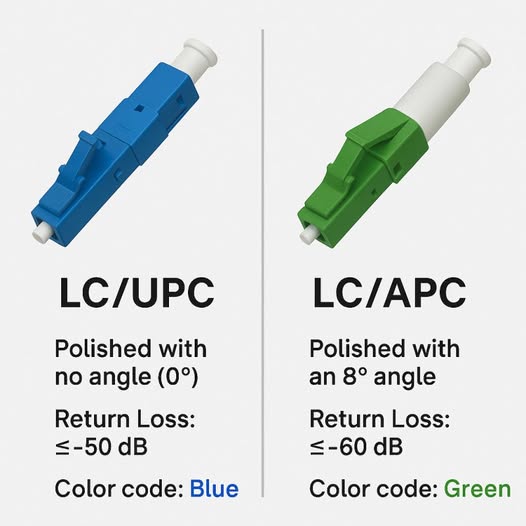
APC (Angular Physical Contact) and UPC (Superphysical Contact) are two key types of end face polishing in fiber optic connectors
The end face of the UPC connector is slightly curved in a dome shape, achieving a return loss of around -50dB through close physical contact. It is suitable for scenarios such as digital TV, data centers, and enterprise networks that require high signal stability. Its blue shell is easy to identify;
The end face of the APC connector is polished at an 8 ° angle to redirect the reflected light to the fiber cladding, with a return loss as low as -60dB or less, making it the preferred choice for RF video transmission, FTTx, and WDM systems. The green casing is a prominent identifier for it. Although both are committed to reducing optical signal loss, APC typically has higher costs than UPC due to its high precision requirements for bevel machining and vulnerable end faces. Additionally, forced docking between the two can lead to a significant increase in insertion loss due to incompatible end face structures.
References: https://en.wikipedia.org/wiki/Optical_fiber_connector
What is a fiber optic loopback?