What is the difference between WDM and OTN?
What is WDM?
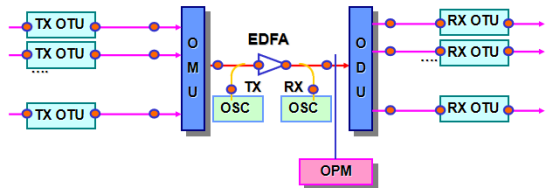
Simply put, WDM refers to a technology that allows multiple wavelengths of optical signals to be transmitted through a single optical fiber.
WDM, also known as wavelength division multiplexing, is a fiber optic communication technology. Since WDM is a communication technology, it inevitably involves both the sender and receiver.
At the transmitting end, optical signals of different wavelengths are combined together through a multiplexer (such as a wavelength division multiplexer) and coupled into an optical fiber for transmission.
At the receiving end, the combined optical signals are separated into optical signals of different wavelengths through a demultiplexer (such as a wavelength division multiplexer) and processed separately.
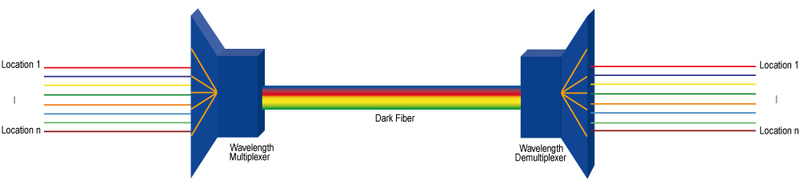
In practical applications, WDM has two forms, namely the classification of WDM:
1. Coarse wavelength division multiplexing (CWDM) wavelength spacing: The wavelength spacing is relatively large, usually 20nm. Application scenario: Suitable for metropolitan area networks with short transmission distances and low capacity requirements, with relatively low cost.
2. Dense Wavelength Division Multiplexing (DWDM) wavelength spacing: The wavelength spacing is relatively small, usually 0.8nm, 0.4nm, or even smaller. Application scenario: Mainly used for long-distance and high-capacity trunk transmission, it can achieve extremely high transmission capacity on a single optical fiber. Currently, WDM is widely used, mainly due to its significant advantages in communication.
Advantages of WDM: 1 Improving fiber utilization: One fiber can simultaneously transmit multiple optical signals of different wavelengths, greatly increasing the transmission capacity of the fiber and reducing the cost of unit bit transmission. 2. Good compatibility: It can be compatible with existing fiber optic communication systems, making it easy to upgrade and expand network capacity. 3. Strong flexibility: The number of wavelengths can be flexibly increased or decreased according to actual needs, and the transmission capacity of the network can be adjusted.
What is OTN?
After discussing WDM, let's talk about OTN.
OTN, also known as Optical Transport Network, is a network architecture based on fiber optic communication technology. OTN is a WDM based optical transport network that combines some advantages of SDH, such as rich OAM overhead, flexible business organization, and comprehensive protection modes. OTN business sorting is divided into optical layer sorting and electrical layer sorting. Optical layer combing can be understood as WDM, while electrical layer combing can be understood as SDH.
1. The layered structure of OTN: OTN works together through the optical and electrical layers to transparently transmit customer signals (such as SDH, Ethernet, etc.), and utilizes WDM technology to improve bandwidth utilization (as can be seen here, OTN is based on WDM technology). Its hierarchical structure from top to bottom includes: Optical Channel Layer (OCH): responsible for routing and wavelength allocation of optical signals, supporting transparent transmission. Optical Multiplexing Segment Layer (OMS): Manage the multiplexing and demultiplexing of multi wavelength signals to ensure signal integrity. Optical Transport Segment (OTS): Processing the transmission of optical signals over physical media such as optical fibers, including devices such as optical amplifiers.
2. The technical advantages of OTN are high-capacity transmission: using DWDM technology, a single fiber can carry tens of Tbit/s of traffic. Transparency: Supports indiscriminate transmission of multiple customer signals (such as SDH, ATM, Ethernet). Efficient management: Provides powerful overhead monitoring (such as OTUk frame structure), fault location, and protection switching functions (such as line protection and wavelength protection). Flexibility: Supports dynamic bandwidth allocation and flexible business scheduling, adapting to the needs of data centers, 5G networks, and other scenarios. OTN has become the core technology of modern communication networks due to its advantages of high bandwidth, low latency, and strong reliability. In the future, it will develop towards higher bandwidth (such as 800G), intelligence (AI driven network management), and green energy conservation, further supporting emerging technologies such as the Internet of Things and 6G.
OTN Site Model:
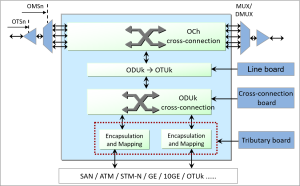
The electrical layer hardware architecture of OTN equipment is the same as that of SDH equipment: branch board+cross connection board+circuit board.
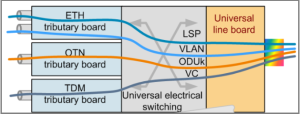
The difference between WDM and OTN
WDM technology is only applicable to the optical layer and not to the electrical layer. OTN contains both optical and electrical layers.
In traditional WDM networks, one wavelength can only transmit one type of service. In OTN networks, one wavelength can simultaneously transmit multiple services.
3. Traditional WDM sites only have OTU boards (wavelength conversion units). In OTN, the OTU board is divided into two parts: branch board and circuit board, and an electrical cross connection board is added. The OTU board can also be directly installed on OTN products.
4. The powerful overhead control and monitoring capabilities of OTN enhance the self-healing protection and reliability of the network. WDM technology can only provide optical layer protection, while OTN technology can provide both optical layer protection and electrical layer protection simultaneously.
5. OTN supports more types of services and has higher board level integration.
6. Through electrical layer cross connection sorting, OTN can flexibly schedule and allocate channel resources, improving bandwidth resource utilization.
WDM technology does not have a corresponding frame structure, while OTN technology has a complete frame structure.
8. OTN sites use a large number of circuit boards, resulting in higher network construction costs. WDM sites use fewer circuit boards, resulting in lower network construction costs.
9. Different application scenarios. Traditional WDM is mainly applied to the access layer at the network edge as an OTM site. OTN networks can provide cross connections for large granularity services. OTN networks can be applied to the aggregation layer and core layer as OADM sites.
What is AWG? Analysis of Core Components in DWDM System
DWDM System: The Outstanding Engine of Optical Communication, Leading the Transformation of Information Transmission
Related Article