The Significance of 800G Optical Modules as a Turning Point in the Development of AI Technology
01 Evolution of 800 Gbit/s optical modules
The optical module undertakes the task of photoelectric signal conversion in the network connection, is responsible for converting the electrical signal into optical signal at the sending end, and then converts the optical signal into electrical signal at the receiving end after transmission through the optical fiber.
With the development and integration of optoelectronic devices, their performance and transmission bandwidth continue to improve, optical modules need higher transmission rates and smaller sizes to adapt to different use scenarios. Packaging methods are also evolving, and smaller packages and power consumption mean that optical modules have a higher port density on the switch, and the same power can drive more optical modules.
Increasing bandwidth requirements
The increase in bandwidth demand has had a significant impact on high-speed optical modules. With the continuous emergence of emerging technologies and the demand for large-scale data transmission, the traditional 100G, 200G, 400G optical modules have been unable to fully meet the market demand. In order to meet the growing bandwidth demand, 800G optical modules are becoming the trend.
The growth of LPO technology
In the era of 800G optical modules, Linear drive Pluggable Optics (LPO) technology stands out. LPO utilizes linear analog components in data links without the need for complex CDR or DSP designs. Compared to DSP solutions, LPO dramatically reduces power consumption and latency, making it ideal for the short-range, high-bandwidth, low-power, and low-latency data connection requirements of AI computing centers. As cloud service providers expand their computing resources, LPO solutions including 800G LPO are expected to capture significant market share.
02 800 Gbit/s optical module package
With the continuous advancement of technology, the packaging form of optical modules has undergone significant evolution. From the early GBIC packages, to smaller SFP packages, to today's 800G QSFP-DD and OSFP packages. This development trend not only reflects the continuous improvement of optical modules in speed, but also shows its progress towards miniaturization and hot swap. 800G optical modules are increasingly used in a wide range of applications, including Ethernet, CWDM/DWDM, connectors, Fibre Channel, and wired/wireless access.
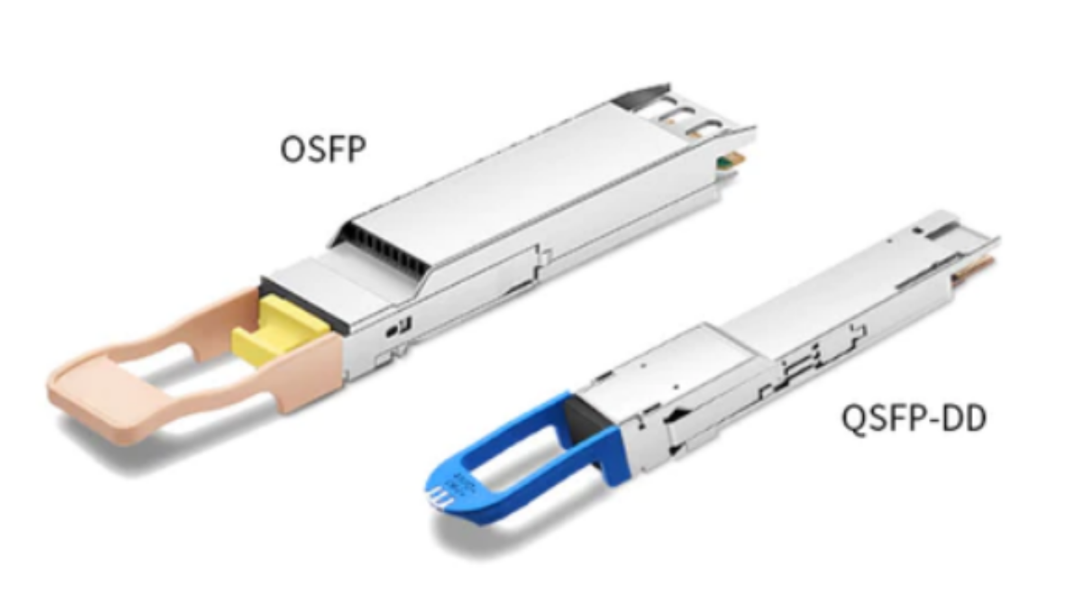
800G QSFP-DD Form factor:
Dual-density four-channel small pluggable high-speed module. QSFP-DD is the preferred package for 800G optical modules today, enabling data centers to efficiently grow and scale cloud capacity as needed. The QSFP-DD module uses an 8-channel electrical interface with rates up to 25Gb/s (NRZ modulation) or 50Gb/s (PAM4 modulation) per channel, providing aggregation solutions up to 200Gb/s or 400Gb/s.
Benefits of 800G QSFP-DD:
1. Backward compatibility, compatible with QSFP+/QSFP28/QSFP56 QSFP package.
2. The 2-by-1 stacked integrated cage connector supports both single-height and double-height cage connector systems.
3. At least 12 watts of heat capacity per module can be achieved through SMT connectors and 1xN cage. The higher heat capacity can reduce the heat dissipation function requirements of the optical module, thereby reducing some unnecessary costs.
4, in the design of QSFP-DD, the MSA working group fully considered the flexibility of user use, the use of ASIC design, support for a variety of interface rates, and can be backward compatible (compatible with QSFP+/QSFP28), thus reducing port costs and equipment deployment costs.
800G OSFP form factor:
OSFP is a new optical module, much smaller than CFP8, but slightly larger than QSFP-DD, with 8 high-speed electrical channels, each 1U front panel still supports 32 OSFP ports, with integrated heat sink can greatly improve the heat dissipation performance.
Benefits of 800G OSFP:
1. The OSFP module is designed with 8 channels and directly supports a total throughput of up to 800G, thus achieving higher bandwidth density.
2, Because the OSFP package supports more channels and higher data transfer rates, it can provide higher performance and longer transmission distances.
3. The OSFP module has an excellent thermal design and can handle higher power consumption.
4.OSFP is designed to support higher rates in the future. Due to the larger size of the OSFP module, it is possible to support higher power consumption and thus higher rates, such as 1.6T or higher.
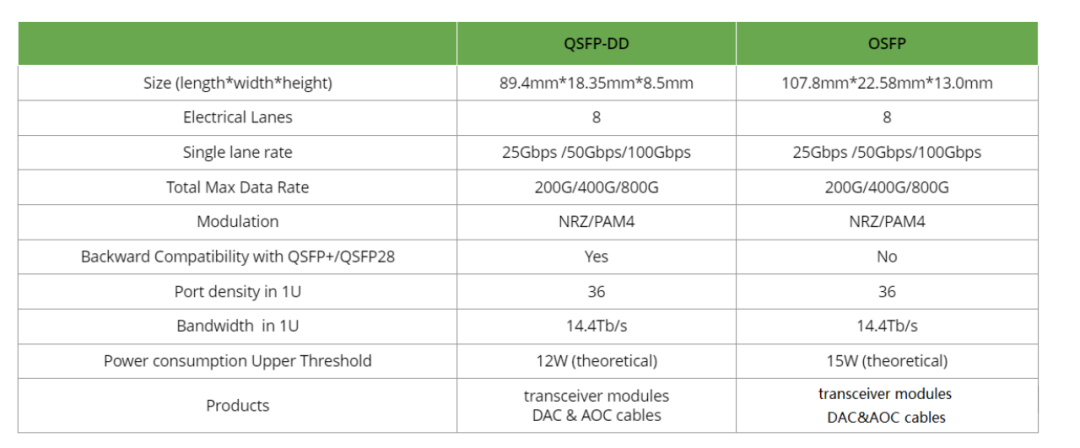
QSFP-DD is often preferred in telecommunications applications, and OSFP is more suitable for data center environments. The main differences between the two are:
1) Size: The OSFP size is slightly larger
2) Power consumption: OSFP power consumption is slightly higher than QSFP-DD.
3) Compatibility: QSFP-DD is perfectly compatible with QSFP28 and QSFP+, while OSFP is not.
03 Type of 800 Gbit/s optical module
800G=8*100G=4*200G, so it can be divided into two categories according to the single-channel rate, that is, single-channel 100G and 200G. The corresponding architecture is shown in the following figure. Single-channel 100G optical modules can be quickly implemented, while 200G requires higher requirements for optical devices. Since the current maximum speed supported by the electrical interface is 112Gbps PAM4, the gearbox needs to be converted for a single channel of 200G.
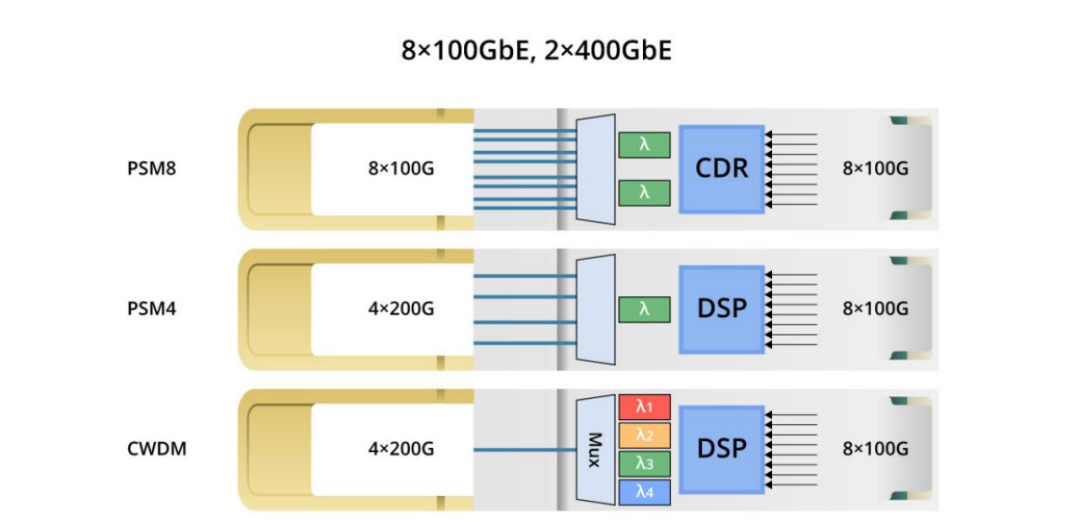
1) 800G SR8
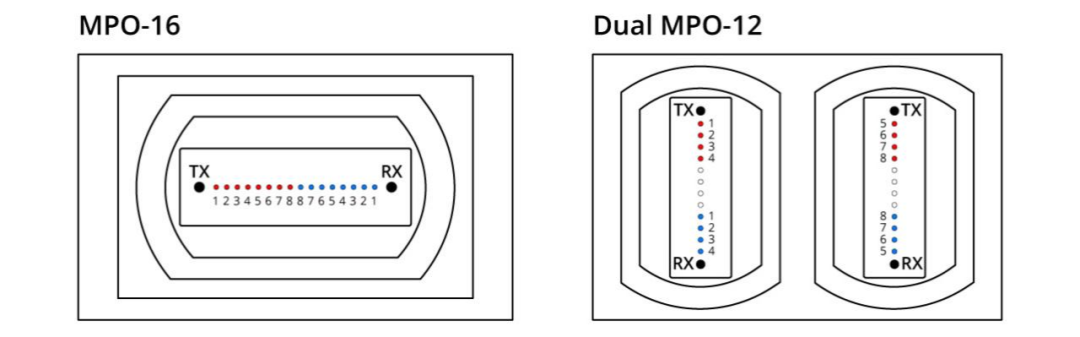
It uses a VCSEL scheme with a wavelength of 850nm and a single channel rate of 100Gbps PAM4, requiring 16 optical fibers. This can be seen as an upgraded version of the 400G SR4 with double the number of channels. The optical interface is MPO-16 or 2-row MPO-12, as shown in the following figure. The 800G SR8 optical module is generally used for 800G Ethernet, data center links, or 800G-800G interconnection.
2) 800G SR4
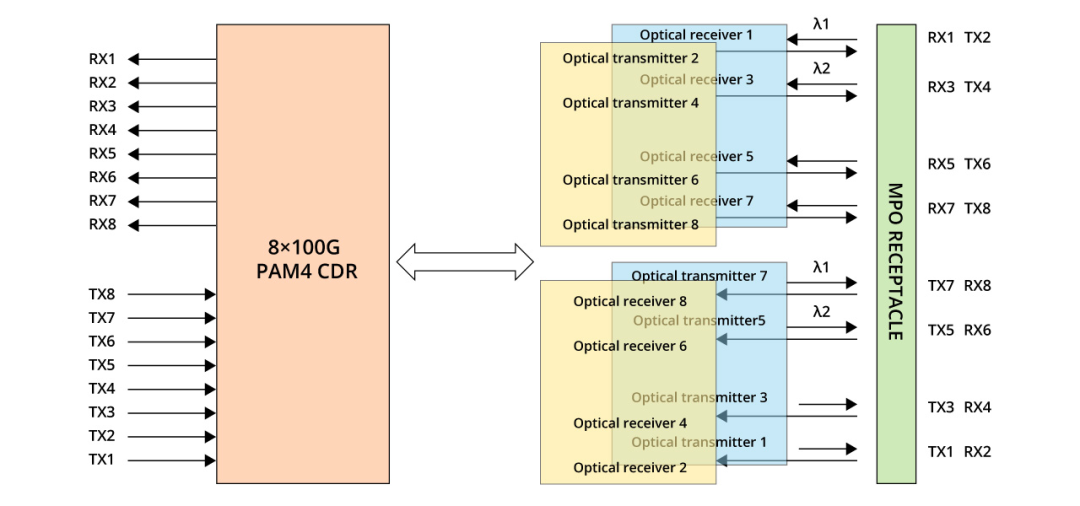
The scheme uses 850nm/910nm wavelength, bidirectional transmission, using DeMux in the module to separate the two wavelengths. The single-channel rate is 100Gbps PAM4 and requires 8 optical fibers. Compared to the SR8, the amount of fiber in this scheme is reduced by half. Its block diagram is shown below:
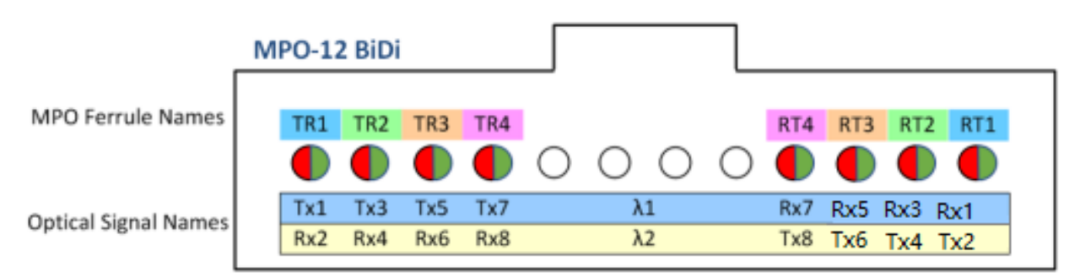
The optical fiber interface is shown in the following figure and uses the MPO-12 interface.
For single-mode cases, 800G optical modules have a variety of standards:
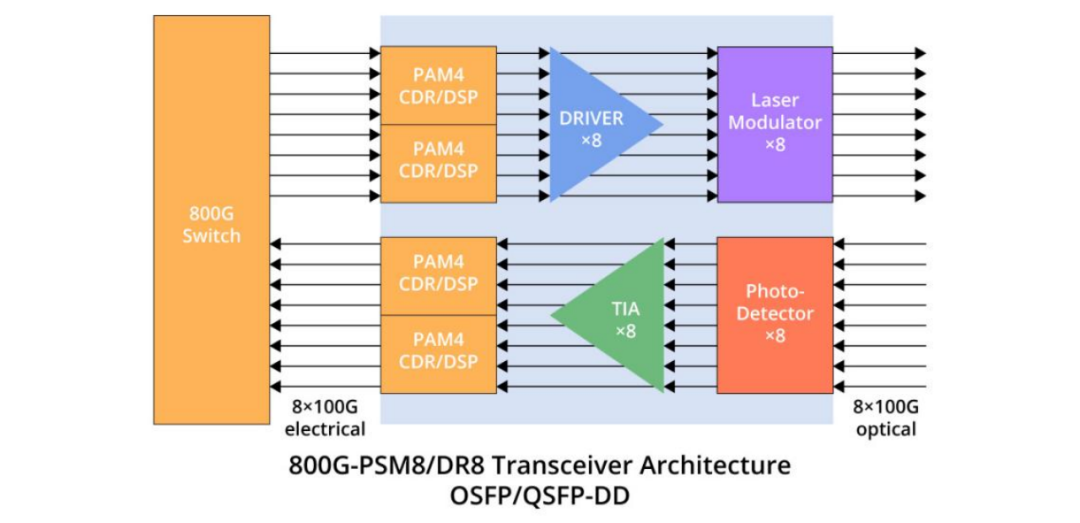
1) 800G DR8, 800G 2xDR4 and 800G PSM8
The internal architecture of these three standards is similar, all 8 send and 8 receive, single channel rate 100Gbps, require 16 optical fibers.
The 800G DR8 optical module uses 100G PAM4 and 8-channel single-mode parallel technology, and the transmission distance through single-mode fiber can reach 500m, which is usually used in data centers, 800G-800G, 800G-400G, 800G-100G interconnection.
The 800G PSM8 uses CWDM technology, has eight optical channels, each optical channel transmission rate of 100Gbps, support 100m transmission distance, very suitable for long-distance transmission and fiber resource sharing.
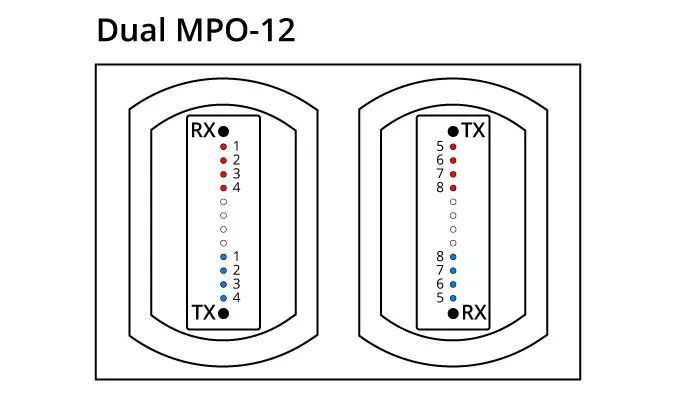
800G 2DR4 refers to two 400G-DR4 ports. The optical ports of 2DR4 are two MPU-12 ports, as shown in the following figure. It can be connected to the 400G DR4 optical module without optical fiber branch cables and supports a transmission distance of 500m, facilitating data center upgrade. The optical interface of PSM8 and DR8 is MPO-16.
2) 800G 2xFR4 and 2xLR4
The internal structure of the two standards is similar, and both contain four wavelengths with a single channel rate of 100Gbps. To reduce the number of fibers using Mux, four fibers are required, as shown in the following figure.
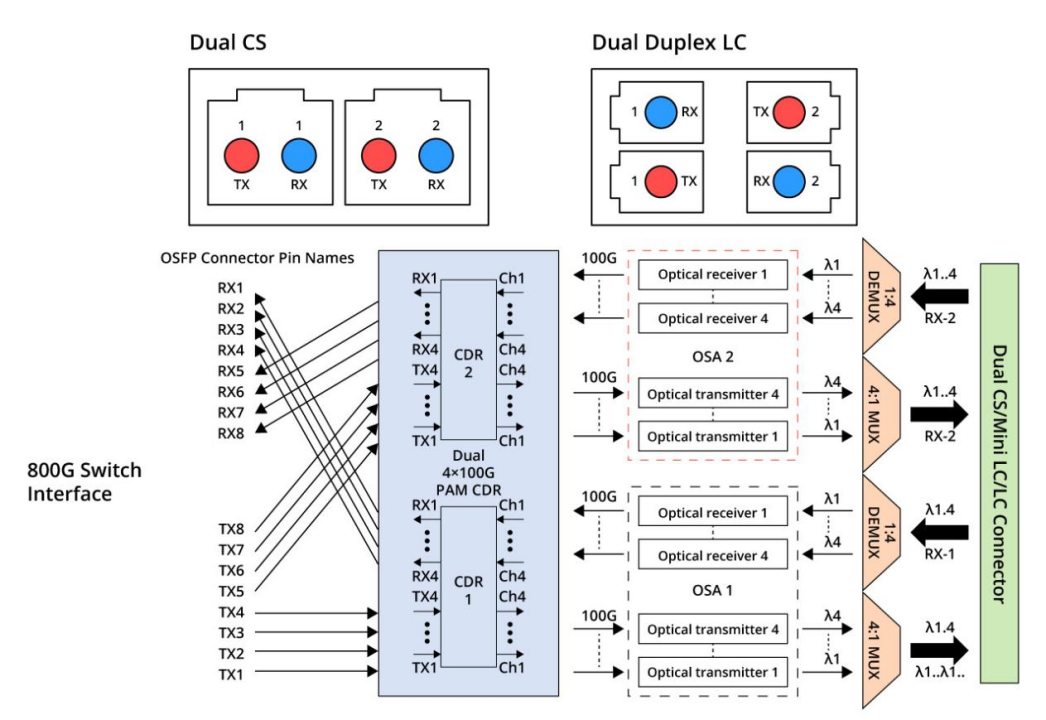
The two solutions are upgrades to the 400G FR4 and LR4 optical modules, using CWDM4 wavelengths of 1271/1291/1311/1331nm. 2xFR4 supports a transmission distance of 2km, and 2xLR4 supports a transmission distance of 10km. The optical interface adopts dual CS or dual LC interface.
3) 800G FR4
The scheme uses four wavelengths, a single channel rate of 200Gbps, and requires two optical fibers to support a transmission distance of 2km, as shown in the figure below.
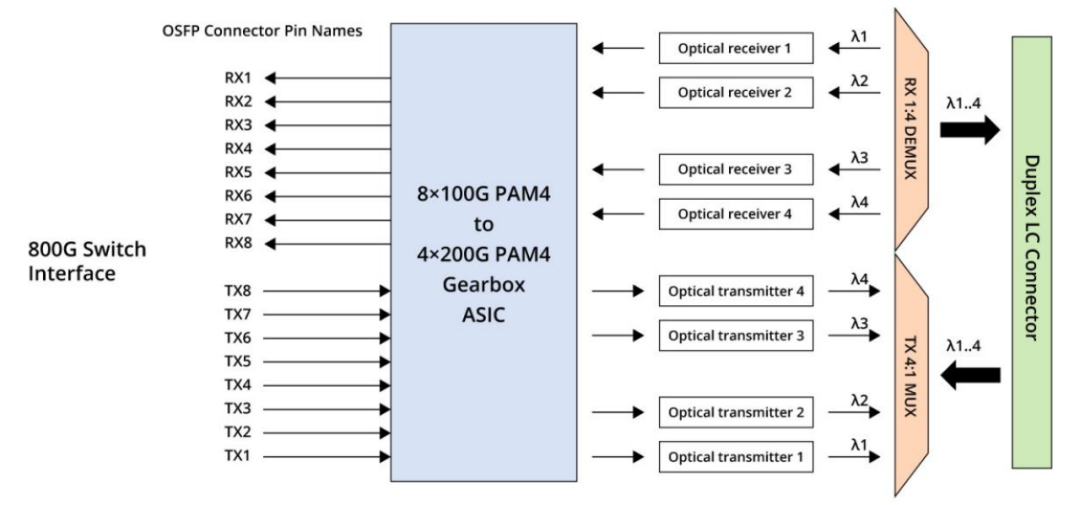
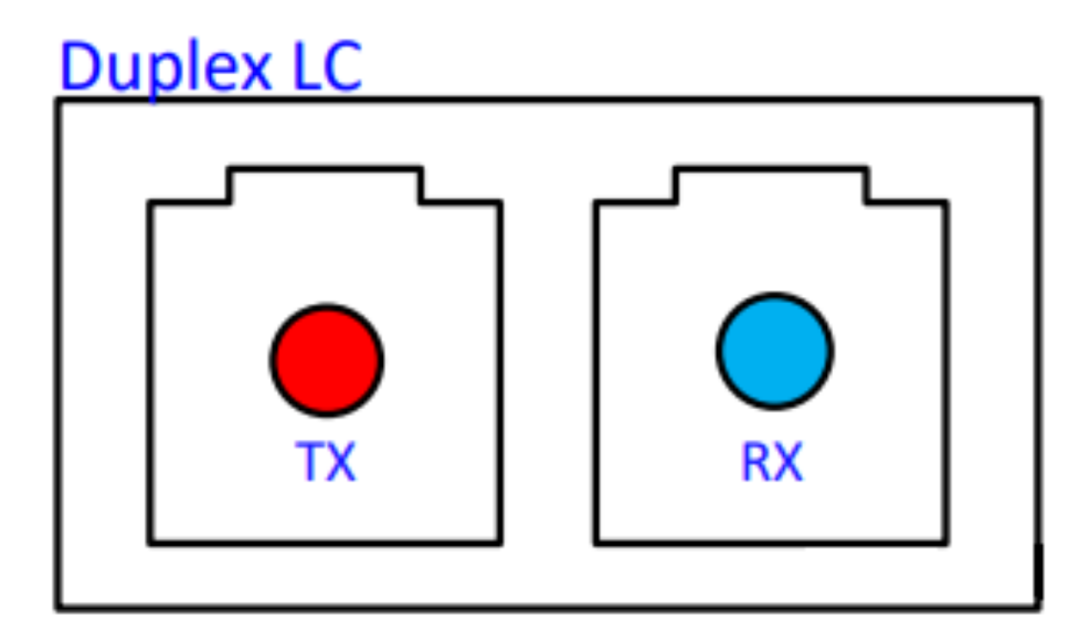
It uses duplex LC optical interface, as shown below
4) 800G FR8
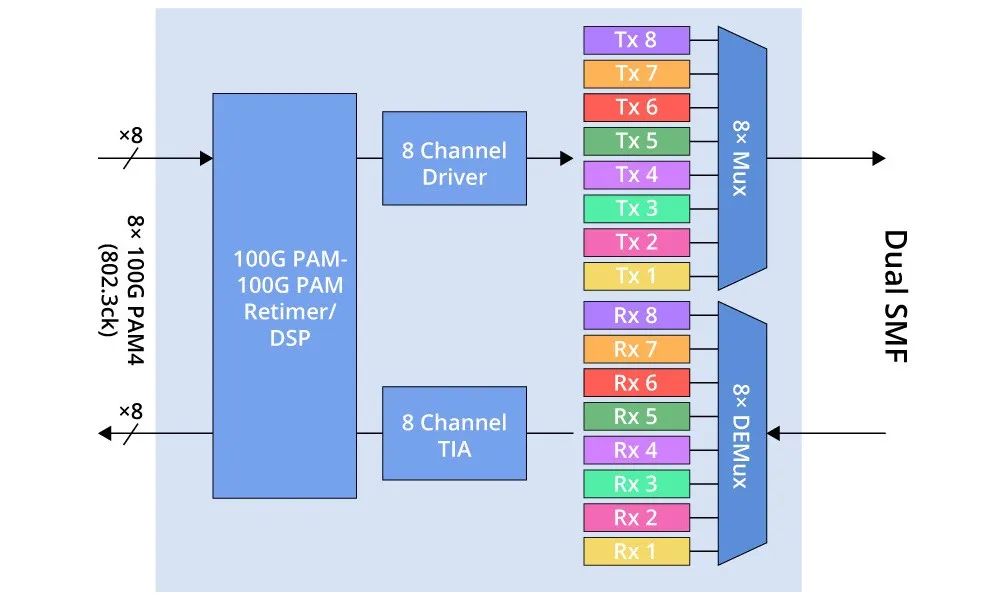
The scheme uses 8 wavelengths, each with a rate of 100Gbps, and requires two optical fibers to support a transmission distance of 2km, as shown in the figure below. Eight wavelength channels for 1271/1291/1311/1331/1351/1371/1391/1411 nm respectively.
04 Al Impact on 800 Gbit/s Optical Module Deployment
Why is 800G more important than 400G for AI servers?
First, AI servers require high data transfer rates and low latency, requiring top-of-rack switches that match the underlying bandwidth. These switches may also require delayed redundancy, which requires high-speed optical modules. For example, the NVIDIA DGX H100 server is equipped with eight H100 GPU modules, each of which requires two 200G optical modules. Therefore, at least 16 200G modules are required for each server, and at least four 800G ports are required for the corresponding top-shelf switch.
Secondly, 800G optical chips have higher cost efficiency and economic benefits. They use 100G EML chips, while 200G/400G uses 50G optical chips. The data shows that at the same speed, the cost of a 100G optical chip is 30% lower than that of two 50G optical chips.
Nevertheless, 400G optical modules are still of great significance in the industry. While they may not match the speed of 800G optical modules, they significantly increase bandwidth compared to older technologies and are the preferred solution for many enterprises. In addition, some applications may not need the full capabilities of 800G Ethernet, and 400G Ethernet is more practical for them.
As the demand for faster and more efficient data transmission continues to surge, the era of 800G optical modules has arrived. With superior bandwidth capabilities and advances in LPO technology, 800G optical modules are set to revolutionize the AI industry and data centers.
Revealing the differences between optical modems, switches and routers, do you know?
Genexis Becomes First Manufacturer Of GPON Products In India
Related Article