What is GPON? Comprehensive analysis of fiber optic access technology
author: Lawson
2025-07-17
GPON History
The development history of GPON (Gigabit Passive Optical Network) can be traced back to the APON/BPON technology in the 1990s. Early APONs were based on ATM architecture, standardized by ITU-T in 1998 (G.983 series), and only supported downlink rates of 155Mbps or 622Mbps. With the surge of Internet demand, ITU-T issued the G.984 standard in 2003, formally defining the GPON technology, replacing ATM with more efficient GEM packaging, and providing 2.5Gbps downlink and 1.25Gbps uplink bandwidth capabilities. Between 2005 and 2010, global operators such as Verizon and China Telecom began to deploy GPON on a large scale to replace traditional DSL and cable broadband. After 2010, GPON became the mainstream technology of FTTH due to its high bandwidth and low cost advantages, and gradually evolved towards XGS-PON (10G GPON).
The development history of GPON (Gigabit Passive Optical Network) can be traced back to the APON/BPON technology in the 1990s. Early APONs were based on ATM architecture, standardized by ITU-T in 1998 (G.983 series), and only supported downlink rates of 155Mbps or 622Mbps. With the surge of Internet demand, ITU-T issued the G.984 standard in 2003, formally defining the GPON technology, replacing ATM with more efficient GEM packaging, and providing 2.5Gbps downlink and 1.25Gbps uplink bandwidth capabilities. Between 2005 and 2010, global operators such as Verizon and China Telecom began to deploy GPON on a large scale to replace traditional DSL and cable broadband. After 2010, GPON became the mainstream technology of FTTH due to its high bandwidth and low cost advantages, and gradually evolved towards XGS-PON (10G GPON).
Overview of GPON Technology
GPON (Gigabit Capable Passive Optical Network) is one of the mainstream broadband fiber optic access technologies. As an important branch of PON (Passive Optical Network) technology, GPON uses a single fiber to transmit data and implements a point-to-point network architecture through optical splitters. This technology was developed by the International Telecommunication Union's Telecommunication Standardization Sector (ITU-T), with the standard number G.984. x series. Compared to traditional active optical networks, GPON has significant advantages such as long transmission distance, high bandwidth, and low maintenance costs. It has become the preferred technology solution for major telecommunications operators worldwide to build FTTH (Fiber to the Home) networks.
GPON (Gigabit Capable Passive Optical Network) is one of the mainstream broadband fiber optic access technologies. As an important branch of PON (Passive Optical Network) technology, GPON uses a single fiber to transmit data and implements a point-to-point network architecture through optical splitters. This technology was developed by the International Telecommunication Union's Telecommunication Standardization Sector (ITU-T), with the standard number G.984. x series. Compared to traditional active optical networks, GPON has significant advantages such as long transmission distance, high bandwidth, and low maintenance costs. It has become the preferred technology solution for major telecommunications operators worldwide to build FTTH (Fiber to the Home) networks.
The network architecture composition of GPON
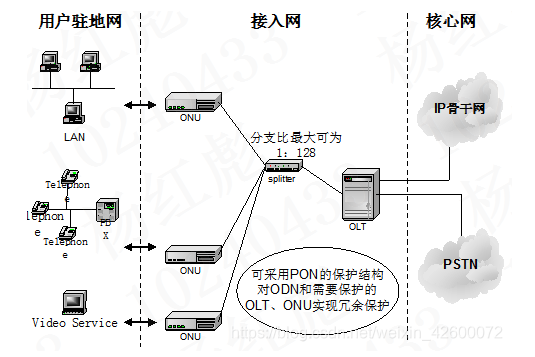
The GPON network mainly consists of the following three parts:
The GPON network mainly consists of the following three parts:
1. OLT (Optical Line Terminal)
Located in the operator's data center, responsible for controlling and managing the entire PON network.
Connect to the core network (such as Internet, IPTV, VoIP and other services).
Located in the operator's data center, responsible for controlling and managing the entire PON network.
Connect to the core network (such as Internet, IPTV, VoIP and other services).
2. ODN (Optical Distribution Network)
Including passive devices such as optical fibers, splitters, connectors, etc.
Responsible for distributing optical signals from OLT to multiple ONUs.
Including passive devices such as optical fibers, splitters, connectors, etc.
Responsible for distributing optical signals from OLT to multiple ONUs.
3.ONU/ONT (Optical Network Unit/Terminal)
Installed on the user end, responsible for converting optical signals into electrical signals for use by devices such as computers, mobile phones, and televisions.
Installed on the user end, responsible for converting optical signals into electrical signals for use by devices such as computers, mobile phones, and televisions.
The core technical features of GPON
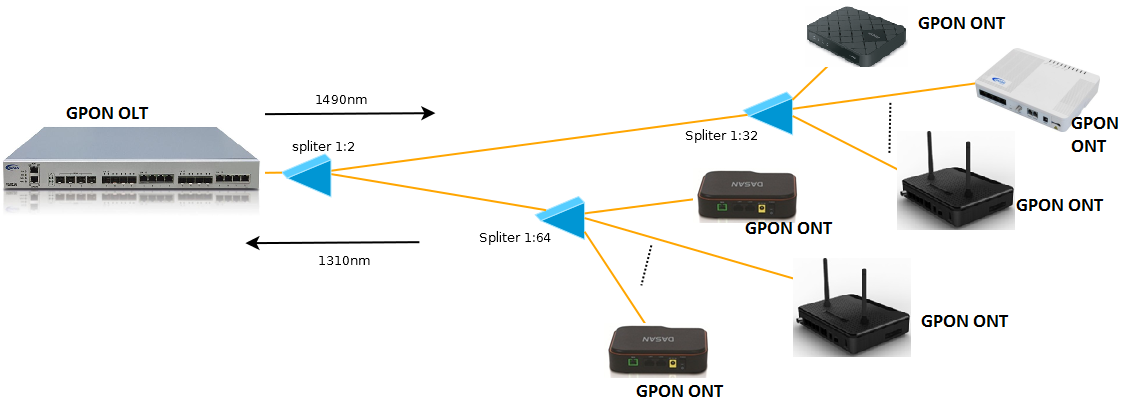
The most prominent technical feature of GPON is reflected in its outstanding performance indicators. In terms of transmission rate, GPON supports asymmetric transmission rates of 2.488Gbps downstream and 1.244Gbps upstream, fully meeting the high bandwidth requirements of modern broadband applications. In terms of transmission distance, GPON supports a maximum logical transmission distance of 20 kilometers, and the actual physical transmission distance can reach 60 kilometers. GPON adopts wavelength division multiplexing (WDM) technology, using 1490nm wavelength to transmit downstream data, 1310nm wavelength to transmit upstream data, and 1550nm wavelength can be selected for video broadcasting services. In addition, GPON also adopts the powerful GEM (GPON Encapsulation Method) encapsulation protocol, which supports efficient frame encapsulation and QoS guarantee mechanisms.
GPON has many advantages, enabling fast, flexible, and large-scale fiber deployment at the lowest cost of ownership and deployment. Immediately consult ZG Tech for GPON products, please refer to the official website www.optical-solution.com.
The most prominent technical feature of GPON is reflected in its outstanding performance indicators. In terms of transmission rate, GPON supports asymmetric transmission rates of 2.488Gbps downstream and 1.244Gbps upstream, fully meeting the high bandwidth requirements of modern broadband applications. In terms of transmission distance, GPON supports a maximum logical transmission distance of 20 kilometers, and the actual physical transmission distance can reach 60 kilometers. GPON adopts wavelength division multiplexing (WDM) technology, using 1490nm wavelength to transmit downstream data, 1310nm wavelength to transmit upstream data, and 1550nm wavelength can be selected for video broadcasting services. In addition, GPON also adopts the powerful GEM (GPON Encapsulation Method) encapsulation protocol, which supports efficient frame encapsulation and QoS guarantee mechanisms.
GPON has many advantages, enabling fast, flexible, and large-scale fiber deployment at the lowest cost of ownership and deployment. Immediately consult ZG Tech for GPON products, please refer to the official website www.optical-solution.com.
Fiber to the Home (FTTH) and Ethernet Passive Optical Network (EPON): The Core Technologies Leading Future Network Access
Related Article
This article mainly elaborates on the growth of data services, the evolution of access network technologies, and focuses on introducing the characteristics, architectures, and key technologies of EPON and WDM - PON in the context of the booming development of various Internet applications and the resulting demand for high - speed and stable network access, highlighting their importance and potential in future network access.
Fiber to the Home (FTTH) and Ethernet Passive Optical Network (EPON): The Core Technologies Leading Future Network Access

What are the differences between optical modems, switches, and routers?# In today's highly connected world, optical modems, switches, and routers are important components of building network infrastructure, and they each play an indispensable role. Have you ever wondered about the differences between them? Let's uncover this network fog together.
Revealing the differences between optical modems, switches and routers, do you know?

With the emergence of AI applications and large models, computing power has become a critical infrastructure of the AI industry, creating an unprecedented demand for high-speed data transmission. As this demand for faster communication increases, high-speed optical modules have become a vital component of AI servers. In this article, we explore the evolution of 800G optical modules and their enormous potential in the era of artificial intelligence.
The Significance of 800G Optical Modules as a Turning Point in the Development of AI Technology