Fiber to the Home (FTTH) and Ethernet Passive Optical Network (EPON): The Core Technologies Leading Future Network Access
Fiber to the Home (FTTH) and Ethernet Passive Optical Network (EPON): The Core Technologies Leading Future Network Access
In today's era of rapid digital development, Internet applications have emerged in a tidal wave, profoundly changing people's lives and workstyles. From high-definition video conferencing to cloud storage services, from virtual reality (VR) experiences to smart home controls, each application places higher demands on network bandwidth and stability. According to statistics, globally, billions of people conduct video calls via the Internet every day, and the usage rate of high-definition video conferencing has increased several times in the past few years. In the enterprise field, the demand for cloud storage services has exploded, with enterprise data volume increasing at an average annual rate of over 50%. The market size of the smart home is expected to exceed hundreds of billions of dollars in the next few years, and the real-time data transmission of a large number of devices requires a powerful network. The booming development of these data application scenarios has made traditional access methods such as xDSL and Cable Modem unable to meet the growing bandwidth demands. Against this backdrop, Fiber to the Home (FTTH) technology has emerged, and Ethernet Passive Optical Network (EPON), as one of the key technologies of FTTH, is gradually becoming the mainstream choice in the network access field with its unique advantages.
在当今数字化高速发展的时代,互联网应用如潮水般涌现,深刻改变了人们的生活和工作方式。从高清视频会议到云存储服务,从虚拟现实(VR)体验到智能家居控制,每一项应用都对网络带宽和稳定性提出了更高要求。据统计,全球范围内,每天有数十亿人次通过互联网进行视频通话,高清视频会议的使用率在过去几年中增长了数倍。在企业领域,云存储服务的需求呈爆炸式增长,企业数据量以年均超过 50% 的速度递增。智能家居市场规模预计在未来几年内将突破千亿美元,海量设备的实时数据传输需要强大的网络支持。这些数据实际应用场景的蓬勃发展,使得传统的接入方式,如 xDSL 和 Cable Modem,已难以满足日益增长的带宽需求。在这样的背景下,光纤到户(FTTH)技术应运而生,而以太无源光网络(EPON)作为 FTTH 的关键技术之一,正凭借其独特的优势,逐渐成为网络接入领域的主流选择。
I. Growth of Data Services: The Core Driving Force for Network Technology Innovation
一、数据业务增长:推动网络技术革新的核心动力
Looking back at the development history of the Internet, since 1990, data services have grown at an astonishing average annual rate of 100%, and between 1995 and 1996, due to the application of technologies such as WDM, the growth rate soared to 1000%. Up to now, the number of Internet users in China has exceeded 111 million, among which broadband Internet users have reached 64.3 million.
回顾互联网的发展历程,自 1990 年以来,数据业务以年均 100% 的惊人速度增长,1995 - 1996 年间,因 WDM 等技术的应用,增速更是飙升至 1000%。截至目前,我国网民数量已超 1.11 亿,其中宽带上网用户达 6430 万人。
Among the numerous Internet applications, instant messaging (IM) applications such as QQ, MSN, and SKYPE have not only greatly increased users' online time but also enhanced their dependence on the Internet, and their voice over IP (VoIP) functions have posed a severe challenge to traditional operators. Statistics show that the cumulative duration of voice calls made through instant messaging software worldwide reaches billions of minutes every day. Peer-to-peer (P2P) applications such as BT, eDonkey, and PPLive can fully utilize network resources and achieve distributed downloads. However, due to their extensive use in the distribution of pirated audio and video resources, they occupy a large amount of core network resources and have caused many management difficulties. For example, after the release of a popular film or television work, the traffic downloaded through P2P often accounts for a large proportion of the total network traffic. Internet Protocol Television (IPTV), as a television service based on IP, requires a bandwidth of about 10Mbps for a single channel, and online games also need at least 10Mbps of bandwidth to provide a smooth experience. Massively multiplayer online role-playing games (MMORPGs) such as World of Warcraft have millions of simultaneous online players during peak periods, and their requirements for network bandwidth and stability are extremely high.
在众多互联网应用中,即时通信(IM)如 QQ、MSN、SKYPE 等,不仅极大地增加了用户的在线时长,还提升了用户对互联网的依赖度,其语音通话功能(VoIP)已对传统运营商构成了严峻挑战。据统计,全球每天通过即时通信软件进行语音通话的时长累计达到数十亿分钟。P2P 应用如 BT、电驴、PPLive 等,虽能充分利用网络资源,实现分布式下载,但由于大量用于盗版影音资源的传播,占用了大量核心网络资源,引发了诸多管理难题。例如,热门影视作品发布后,通过 P2P 下载的流量常常占据网络总流量的很大比例。IPTV 作为基于 IP 的电视服务,单频道带宽需求约 10Mbps,而网络游戏为提供流畅体验,也至少需要 10Mbps 的带宽。大型多人在线角色扮演游戏(MMORPG)如《魔兽世界》,高峰期同时在线玩家数以百万计,其对网络带宽和稳定性的要求极高。
The vigorous development of these applications has made traditional access methods such as xDSL and Cable Modem seem inadequate, and there is an urgent need for a faster and more stable access technology. Therefore, FTTH has attracted much attention.
这些应用的蓬勃发展,使得传统的 xDSL 和 Cable Modem 接入方式显得力不从心,迫切需要一种更高速、更稳定的接入技术,FTTH 因此备受瞩目。
II. Evolution of the Access Network: From Competition among Multiple Technologies to the Rise of EPON
二、接入网演变:从多种技术竞争到 EPON 脱颖而出
The access network technology has undergone a long evolutionary process, and multiple technologies have shown their capabilities. xDSL technologies include ADSL, ADSL2, ADSL2+, VDSL, etc. Although they have continuously evolved, they still have limitations in bandwidth and transmission distance. For example, in some remote areas, due to line quality issues, the actual download speed of ADSL may be much lower than the theoretical value. Point-to-point Ethernet technology can provide relatively wide bandwidth and long transmission distance. However, it requires a large number of fiber optic cables and a large number of optical transceiver modules at the central office, resulting in high costs and being unsuitable for densely populated user areas. Cable Modem has problems such as shared network bandwidth, low security, and high two-way transformation costs, while power line communication (PLC) has almost negligible market share due to security and standard obstacles.
接入网技术经历了漫长的演变过程,多种技术曾各显神通。xDSL 技术包括 ADSL、ADSL2、ADSL2+、VDSL 等,尽管不断演进,但在带宽和传输距离上仍存在局限性。例如,在一些偏远地区,由于线路质量问题,ADSL 的实际下载速度可能远低于理论值。点对点以太网技术虽能提供较宽的带宽和较长的传输距离,然而其使用的光纤光缆数量众多,且局端需要大量光收发模块,成本高昂,不适用于用户密集区域。Cable Modem 存在网络带宽共享、安全性低、双向改造费用高等问题,而电力线上网(PLC)因安全性和标准障碍,市场份额几乎可以忽略不计。
The emergence of Passive Optical Network (PON) technology has brought new hope for the development of the access network. PON technologies are divided into multiple types such as APON, EPON, GPON, and WDM - PON. Among them, APON has gradually been phased out of the market, and currently, it is mainly a competition between EPON and GPON. EPON has occupied a large market share in the Asia-Pacific region with its relatively high cost performance. For example, in Japan, the market share of EPON in the fiber access market exceeds 50%. Although WDM - PON has the advantages of high bandwidth and good confidentiality, its relatively high cost mainly attracts dedicated network users.
无源光网络(PON)技术的出现,为接入网的发展带来了新的曙光。PON 技术分为 APON、EPON、GPON 和 WDM - PON 等多种类型。其中,APON 已逐渐被市场淘汰,目前主要是 EPON 和 GPON 在竞争。EPON 凭借其较高的性价比,在亚太地区已占据较大市场份额。以日本为例,EPON 在光纤接入市场的占有率超过 50%。WDM - PON 虽具有高带宽和良好保密性的优势,但其成本相对较高,主要吸引专网用户。
III. EPON: An Excellent Technology Integrating Ethernet and PON
三、EPON:融合以太网与 PON 的卓越技术
Definition and Standards
定义与标准
EPON was proposed by IEEE 802.3ah, which perfectly combines Ethernet technology with PON technology, aiming to build a gigabit Ethernet fiber access system with a point-to-multipoint structure in the simplest way. It includes GEPON (gigabit bandwidth) and is currently researching 10GEPON (10-gigabit bandwidth) to meet future higher bandwidth requirements.
EPON 由 IEEE 802.3ah 提出,将以太网技术与 PON 技术完美融合,旨在以简洁高效的方式构建点到多点结构的吉比特以太网光纤接入系统。它包括 GEPO(千兆带宽),并正在研究 10GEPON(万兆带宽),以满足未来更高带宽的需求。
Architecture and Principles
架构与原理
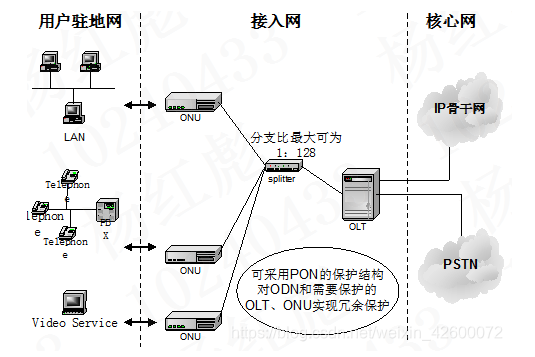
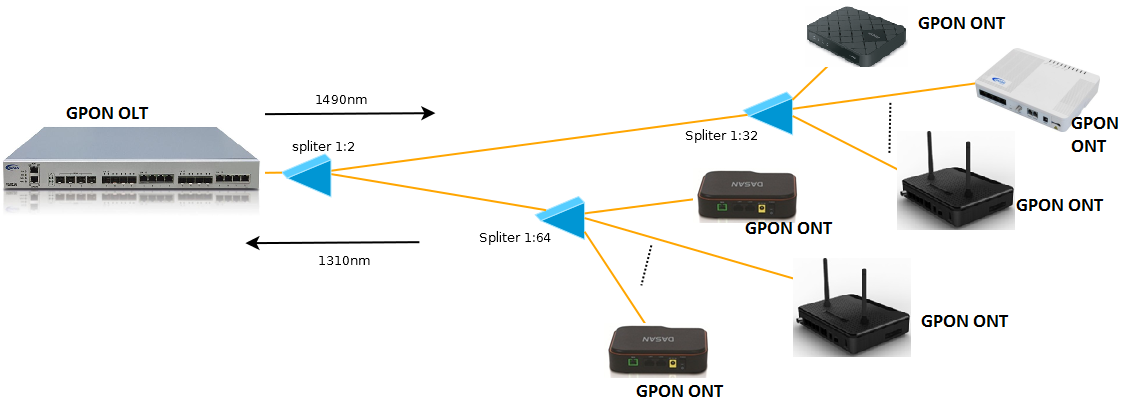
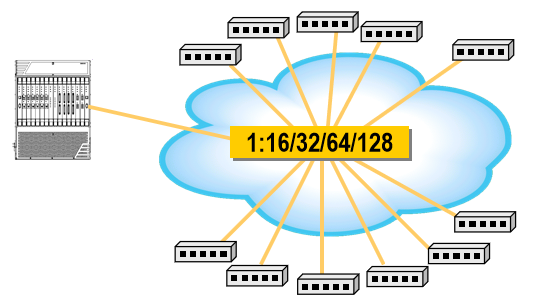
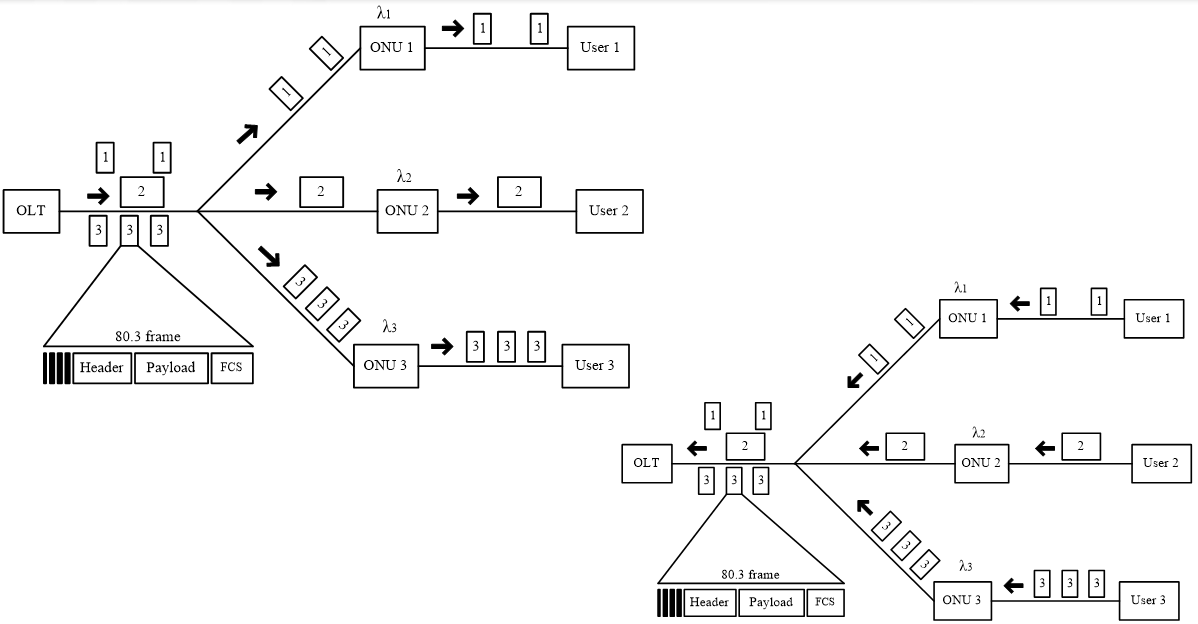
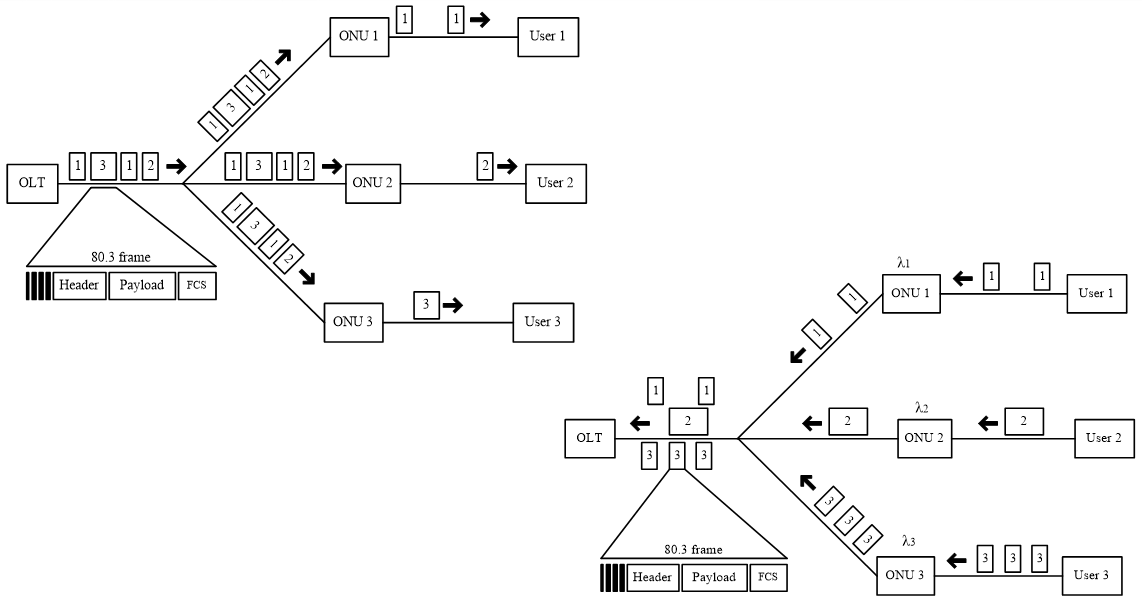
The architecture of EPON is clear, consisting of an Optical Line Terminal (OLT), an Optical Distribution Network (ODN), and Optical Network Units (ONUs). Downstream data is transmitted in a broadcast manner. The OLT sends data to all ONUs through a wavelength of 1490nm, and the ONUs select and receive the data belonging to them according to the Logical Link Identifier (LLID) and mode bits. Upstream data adopts Time Division Multiple Access (TDMA). ONUs send data to the OLT through a wavelength of 1310nm in different time slots, and only one ONU emits light at the same time, thus avoiding data collisions. In practical applications, one OLT can connect multiple ONUs to provide high-speed and stable network access services for multiple users. For example, in a large residential community, one OLT can provide broadband services for hundreds of households.
EPON 的架构清晰明了,由光线路终端(OLT)、光分配网络(ODN)和光网络单元(ONU)组成。下行数据采用广播方式,OLT 通过 1490nm 波长将数据发送至所有 ONU,ONU 根据逻辑链路标识(LLID)和模式位选择接收属于自己的数据;上行数据采用时分多址(TDMA)方式,ONU 在不同时隙通过 1310nm 波长向 OLT 发送数据,同一时刻只有一个 ONU 发光,从而避免了数据冲突。在实际应用中,一个 OLT 可以连接多个 ONU,为多个用户提供高速稳定的网络接入服务。例如,在一个大型住宅小区,一个 OLT 可以为数百户居民提供宽带服务。
Key Technologies
关键技术
The key technologies of EPON include burst transmission and reception, registration and automatic discovery, ranging and timing, and request reporting and grant processing. Burst transmission requires ONUs to have a fast response ability with short turn-on and turn-off times. Burst reception requires the OLT to have a wide optical power response range to adapt to ONUs at different distances. The registration and automatic discovery mechanism ensures that newly connected ONUs can be automatically recognized and configured by the OLT. The ranging and timing technology guarantees the accuracy and synchronization of data transmission, and the request reporting and grant processing are used for bandwidth allocation and traffic control between ONUs and the OLT. In enterprise campus networks, these key technologies ensure the stable networking of a large number of office devices and improve office efficiency.
EPON 的关键技术包括突发发射和接收、注册和自动发现、测距和定时以及请求报告和允许处理等。突发发射要求 ONU 具有快速的响应能力,开启和关闭时间短;突发接收则需要 OLT 具备较宽的光功率响应范围,以适应不同距离的 ONU。注册和自动发现机制确保新接入的 ONU 能够自动被 OLT 识别和配置,测距和定时技术保证了数据传输的准确性和同步性,请求报告和允许处理则用于 ONU 与 OLT 之间的带宽分配和流量控制。在企业园区网络中,这些关键技术确保了大量办公设备的稳定联网,提高了办公效率。
IV. WDM - PON: A Promising Star with High Bandwidth and High Performance
四、WDM - PON:高带宽与高性能的潜力之星
WDM - PON mainly uses wavelength division multiplexing technology at the physical layer and is divided into two modes: unidirectional wavelength division and bidirectional wavelength division. In the unidirectional wavelength division mode, the downstream uses broadcast, and the upstream uses wavelength division multiplexing. In the bidirectional wavelength division mode, wavelength division multiplexing is used in both the upstream and downstream directions. Feihong Company has excellent performance in WDM - PON technology. Its unidirectional wavelength division products adopt gigabit broadcast downstream and 100-megabit wavelength division upstream, and its bidirectional wavelength division products achieve bidirectional gigabit wavelength division transmission.
WDM - PON 主要在物理层运用波分复用技术,分为单向波分和双向波分两种方式。单向波分下行采用广播,上行采用波分复用;双向波分则在上下行均使用波分复用。飞鸿公司在 WDM - PON 技术方面表现出色,其单向波分产品采用千兆广播下行、百兆波分上行,双向波分产品实现了双向千兆波分传输。
The key technologies of WDM - PON lie in DWDM or CWDM specific wavelength lasers and multiplexing or demultiplexing devices. In some data center interconnection scenarios with extremely high bandwidth requirements, WDM - PON can provide large-capacity data transmission channels to meet the rapid data exchange needs of massive data. At the same time, in some financial institutions or government department networks with high confidentiality requirements, the good confidentiality of WDM - PON can also effectively protect data security.
WDM - PON 的关键技术在于 DWDM 或 CWDM 特定波长激光器以及复用或解复用器件。在一些对带宽要求极高的数据中心互联场景中,WDM - PON 能够提供大容量的数据传输通道,满足海量数据的快速交换需求。同时,在一些对保密性要求较高的金融机构或政府部门网络中,WDM - PON 的良好保密性也能有效保障数据安全。
In conclusion, with the continuous expansion and deepening of data applications, FTTH and EPON technologies will play an increasingly important role in the future network access field, providing a solid network foundation for people's digital lives and the information development of society.please refer to the official website www.optical-solution.com or contact Yuki< zgsales1@optical-solution.com >.
综上所述,随着数据实际应用的不断拓展和深化,FTTH 和 EPON 技术将在未来网络接入领域发挥愈发重要的作用,为人们的数字化生活和社会的信息化发展提供坚实的网络基础。订购详情,请见官网www.optical-solution.com,或联系邮箱:Yuki
What is GPON? Comprehensive analysis of fiber optic access technology
Revealing the differences between optical modems, switches and routers, do you know?
Related Article