Voltage type adjustable optical Attenuator - Reflective type((MEMS VOA)
author: Jocelin
2024-10-23
MEMS VOA principle
The structure of reflective VOA based on MEMS technology is mainly divided into two parts. A part of it is composed of a collimator consisting of dual core pins and a C-lens, which serves as an input and reflection output channel for light. It can optimize the design of parameters such as the pin slope angle, C-lens curvature radius, and material to produce MEMS VOAs with different specifications. The other part is MEMS seals, which encapsulate MEMS chips in a stable and reliable sealing environment through precision processes such as surface mounting, wire bonding, and vacuum sealing. After applying a voltage of several volts or more to the positive and negative pins of the device, due to the specific structure of the MEMS chip, an electrostatic force is generated between the silicon-based gold-plated surface and the gold-plated reflective surface, driving the MEMS chip reflective surface to rotate at a slight angle, resulting in synchronous displacement of the reflected light incident on the MEMS chip mirror surface, causing a mismatch between the mode field of the returned light and the coupled single-mode fiber mode field, resulting in attenuation. As the applied voltage changes, the attenuation also changes accordingly and is continuously adjustable. When a reverse bias voltage is applied between the positive and negative electrodes, the device can still operate normally.
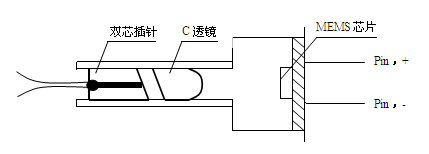
MEMS VOA packaging
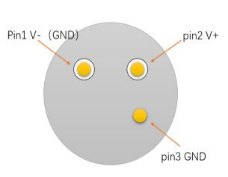
High precision packaging is the key to the production of MEMS VOAs. Guangxun Technology is one of the few optical device companies in China that independently packages and produces reflective MEMS VOAs. The external dimensions of its MEMS VOAs are only 5.5 × 18mm (excluding the length of the soldering pins).

MEMS VOA application
The function of MEMS VOA is to achieve optical path attenuation, and its application directions mainly include several aspects:
1. Used for testing systems or integrating into testing instruments
2. Power balance, combined with OADM, or combined with AWG to form VMUX
3. Integrated into EDFA, adjust output slope, adjust amplifier gain to achieve VGA function
The application scenarios of MEMS VOA are concentrated in backbone networks and metropolitan area networks. The following diagram shows the power balancing of Mems VOA in conjunction with OADM.

Product features:
1. Low insertion loss
2. Low polarization related loss
3. Compact design, small size package, low power consumption
4. Not sensitive to impact and vibration
Application scope:
1. Optical power control
2. Gain control of erbium-doped fiber amplifier
3. Receiver optical path protection system
4. Switch control
The technical indicators of MEMS VOA
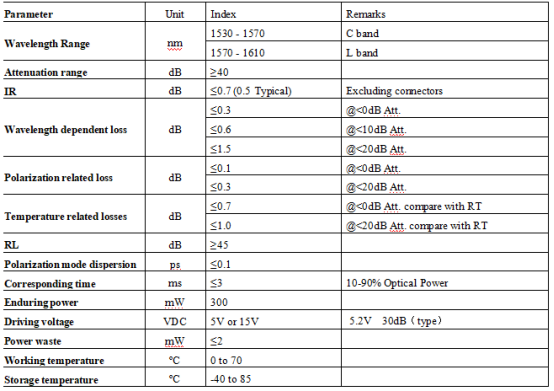
The technical indicators of MEMS VOA mainly include: operating wavelength range, operating temperature, dynamic attenuation range, insertion loss (IL), return loss (RL), polarization related loss (PDL), temperature characteristics, and wavelength related loss (WDL). The main indicators of MEMS VOA manufactured by Guangxun Technology are shown in Table 1, which has reached a high level of the same product in the industry. Compared with similar companies, Guangxun's devices also have better anti-static ability and long-term stability, and can flexibly provide products with different voltage requirements (5V&15V). In addition, its weight is less than 3g, power consumption is less than 5mw, and response time is generally 2-3ms, which is very conducive to module splicing.
Excellent Polarization-Maintaining Products, Locking in Stable Optical Signals without Deviation
Fiber Optic Transceiver: Lightspeed Connection, Endless Possibilities!