Technical White Paper: Outlook for 2026, Top 10 Technological Evolution Trends in the Optical Communication Industry

Preface
Looking at the industry at the end of 2025, the explosive growth of AI computing power has pushed optical communication to a historic turning point. Entering 2026, optical communication is no longer just a carrier of information, but has become the core engine that determines the upper limit of computing power and energy efficiency ratio. This white paper aims to explore the top ten key technological trends that will affect the optical communication landscape in 2026, providing strategic references for industry partners.
Trend 1: 1.6T optical modules enter the first year of large-scale deployment
In 2026, with the widespread adoption of 25.6T and 51.2T switches, 1.6T optical modules will move from laboratories to data centers. Based on the mature single wave 200G technology, the 1.6T module will become the "standard configuration" to solve the bandwidth bottleneck within AI large model clusters, achieving a doubling of performance.
Trend 2: Hollow core fiber (HCF) opens up ultra-low latency commercial applications
The physical limits of traditional quartz optical fibers are being challenged. In 2026, hollow fiber optic cables will be commercially implemented in scenarios that are extremely sensitive to latency, such as high-frequency financial transactions and cross cluster interconnection in smart computing centers. The speed of light transmission in air is nearly 50% faster than in glass, which will completely reshape the latency map of computing power networks.
Trend 3: Scenario based coexistence of CPO and LPO solutions
In 2026, it will no longer be a simple scheme dispute, but a "tailored approach". LPO (linear drive optics) dominates in short-range access due to its low power consumption and cost advantages; CPO (co packaged optics) will become the ultimate choice for ultra large scale computing platforms in solving the bottleneck of extremely high port density and heat dissipation.
Trend 4: Thin film lithium niobate (TFLN) becomes the core of high-speed modulators
With the evolution of bandwidth towards 200G/400G single wave, thin-film lithium niobate technology will become the core material of the high-end modulator market by 2026, breaking some performance limitations of traditional indium phosphide and silicon photonics, thanks to its ultra-high bandwidth, low driving voltage, and excellent linearity.
Trend 5: all-optical switching (OCS) reconstruction of intelligent computing center architecture
To cope with the complex dynamic traffic in AI training, data centers will introduce more Optical Circuit Switching (OCS) in 2026. Compared to electrical switching, OCS can significantly reduce energy consumption and minimize data packet loss, achieving high-speed and transparent physical connections between computing resources.
Trend 6: S+C+L full band transmission breaks capacity crisis
The capacity of single fiber communication is approaching the Shannon limit. In 2026, the backbone network will be fully expanded from the C+L band to the S band. Combined with multi band Raman amplifier technology, the single fiber capacity is expected to exceed 100Tbps, supporting the efficient flow of massive data across regions through "East Data West Computing".
Trend 7: Cross border penetration of silicon photonics technology
By 2026, silicon optical technology will not only dominate the field of optical modules, but also penetrate into on-chip optical interconnect (Optical I/O). Optical interconnection will replace some traditional PCB copper wire connections, directly realizing the "light in and copper out" between CPU/GPU chips, and solving the "I/O wall" problem of chip performance.
Trend 8: AI Empowers Optical Networks
Artificial intelligence is deeply integrated into various aspects of optical networks. By constructing network images through digital twins and combining them with machine learning algorithms, future optical networks will achieve high-order autonomous capabilities such as precise fault prediction, dynamic self optimization of resources, and business intent driven. The operation and maintenance mode will shift from "manual response" to "intelligent prevention and self-healing", significantly improving network availability and energy efficiency.
Trend 9: Coherent technology towards edge networks and short-range sinking
The coherent communication technology that was once exclusively used for long-distance transmission will be widely applied to DCI (Data Center Interconnection) and even metropolitan access networks through highly integrated coherent DSP and silicon optical technology in 2026, achieving higher spectral efficiency over shorter distances.
Trend 10: Green all-optical network helps carbon peak
In 2026, low carbonization will become an important indicator for measuring optical communication technology. The all-optical base is expected to reduce network energy consumption by over 40% by reducing the number of electrical processing steps. Optical communication will serve as a model for "green connectivity" and become a key force in achieving the zero carbon goal of the ICT industry.
Conclusion
Looking ahead to 2026, optical communication is no longer just an auxiliary infrastructure, it has evolved into the "smart neural network" of the computing age. As a pioneer in the field of optical communication, ZG Tech is continuously investing in the research and development of new optical fibers and core passive components, committed to working with global customers to embrace a more transparent, high-speed, and low-carbon all-optical future.
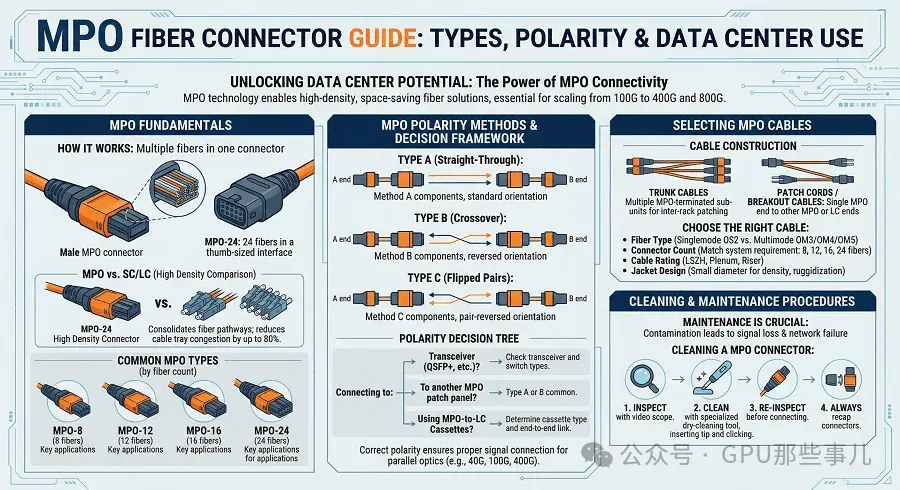
MPO Fiber Connector Complete Guide: Types, Polarity, and Data Center Applications
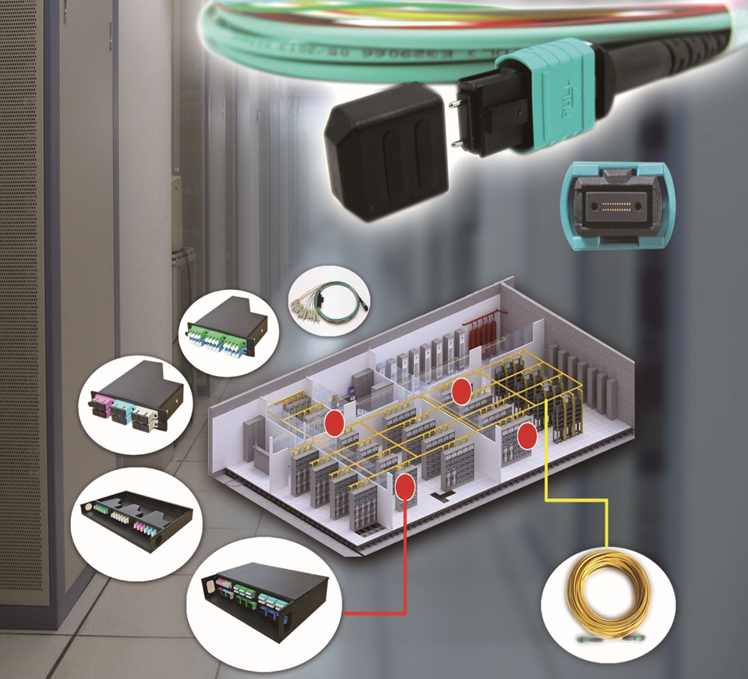
Basic knowledge and skills of data center cabling