What is a fiber optic array?
author: Lawson
2025-09-20
Definition
Fiber Array (FA) is a fundamental optical passive device. Its core function is to fix and package multiple optical fibers in parallel with extremely precise spacing and arrangement on a substrate with micro grooves (such as glass, silicon), forming a standardized multi-channel optical interface.
Fiber Array (FA) is a fundamental optical passive device. Its core function is to fix and package multiple optical fibers in parallel with extremely precise spacing and arrangement on a substrate with micro grooves (such as glass, silicon), forming a standardized multi-channel optical interface.
Structure and Manufacturing
The manufacturing of fiber optic arrays is a high-precision process that mainly includes three parts:
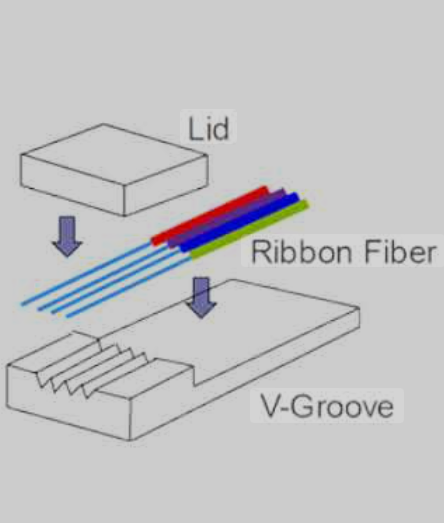
Substrate:
Usually made of glass, silicon, or quartz.
A series of V-grooves with equal spacing and depth are machined on the surface through precision etching technology. These slots are crucial for precise positioning of optical fibers.
A series of V-grooves with equal spacing and depth are machined on the surface through precision etching technology. These slots are crucial for precise positioning of optical fibers.
Optical Fibers:
Use bare fiber with a standard outer diameter (usually 125 µ m) (i.e. without the coating layer).
Place each bare fiber precisely into the V-shaped groove.
Place each bare fiber precisely into the V-shaped groove.
Adhesive and packaging:
Use ultraviolet (UV) curing adhesive or thermosetting adhesive to permanently fix the optical fiber in the groove.
Finally, add a cover plate for packaging and protection.
Finally, add a cover plate for packaging and protection.
Key post-processing - End face polishing:
This is a crucial step. The fixed array end face needs to be ground and polished to make it extremely smooth and flat.
The end face is usually polished to an 8 ° angle, which can minimize the reflection (return loss) of optical signals at the interface and ensure efficient transmission of light.
The end face is usually polished to an 8 ° angle, which can minimize the reflection (return loss) of optical signals at the interface and ensure efficient transmission of light.
Functions and features
The reason why fiber optic arrays are indispensable is due to their following key characteristics:
The reason why fiber optic arrays are indispensable is due to their following key characteristics:
High precision positioning: V-groove technology ensures a very precise distance (Pitch, commonly 250 µ m or 127 µ m) between the cores of all optical fibers.
Low insertion loss: The precise polishing process results in minimal energy loss of the optical signal at the connection point.
High density integration: It can integrate dozens or even hundreds of fiber channels in a very small volume.
High reliability: The sturdy packaging structure enables it to resist environmental influences such as vibration and temperature changes, with stable performance.
Customization flexibility: Fiber types (single-mode, multi-mode, polarization maintaining), channel numbers, grinding angles, and end face shapes can be customized according to needs to adapt to diverse application scenarios.
Customization flexibility: Fiber types (single-mode, multi-mode, polarization maintaining), channel numbers, grinding angles, and end face shapes can be customized according to needs to adapt to diverse application scenarios.
Application scenarios and development
The application scenarios of fiber optic arrays include but are not limited to planar optical waveguides and array waveguide gratings; Active/passive array fiber optic devices, microelectromechanical systems; Multi channel optical module. With the development of the communication field, the demand for high-speed and high-density fiber optic transmission has become increasingly urgent. Expanding one-dimensional fiber arrays into two-dimensional fiber arrays (2D fiber arrays, also known as fiber surface arrays) has become inevitable.
If you still have any questions about fiber optic arrays, please visit our website www.optical-solution.com and contact us through zgsales5@optical-solution.com contact us.
If you still have any questions about fiber optic arrays, please visit our website www.optical-solution.com and contact us through zgsales5@optical-solution.com contact us.
Hollow core fiber: a technological revolution for reconstructing the future of optical communication
Global Optical Communication Industry Trends in 2025: Innovations, Market Shifts, and Key Players