The Difference Between MTP and MPO Fiber and How to Use Them
author: MM
2024-12-09
1. Overview of MPO Fiber
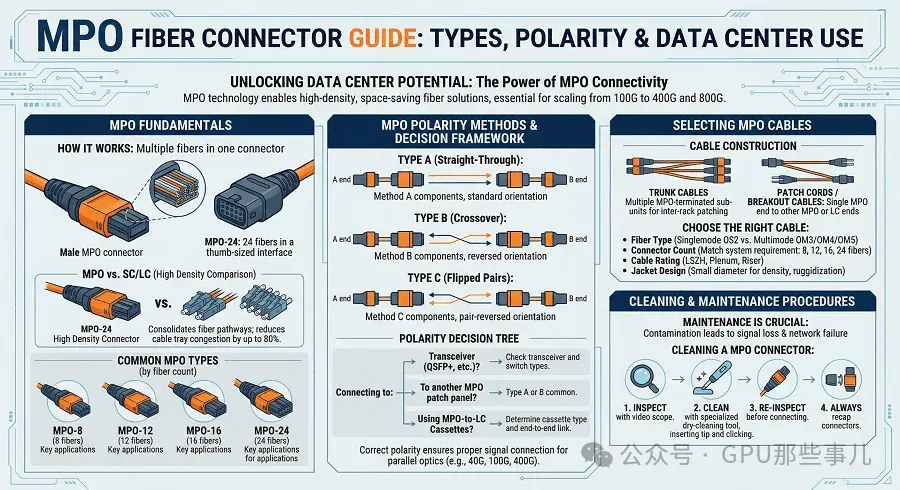
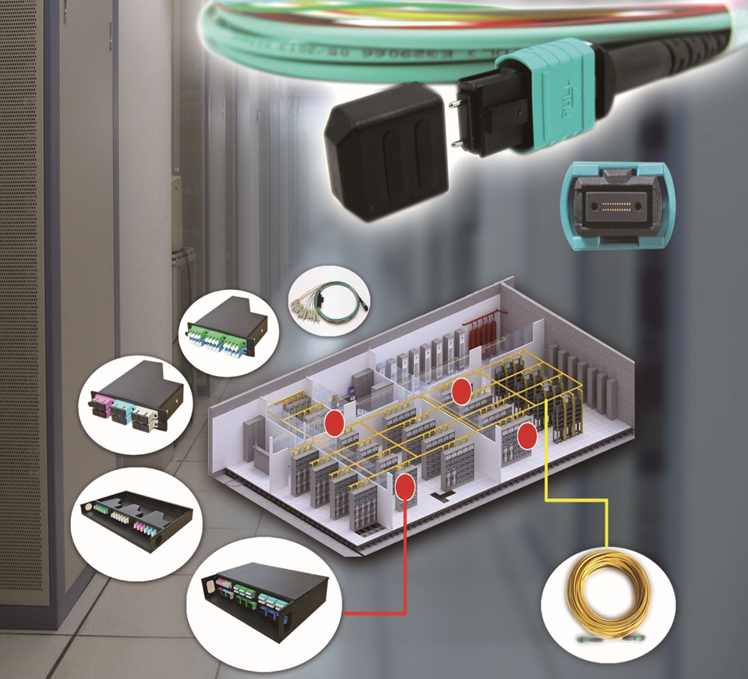
MPO stands for Multi-fiber Push On. MPO fiber generally refers to the commonly used MPO fiber patch cord. This fiber patch cord is a connecting line composed of MPO connectors and optical cables. The connector of MPO fiber patch cord is a type of multi-core fiber connector, which is adopted by the IEEE standard as a type of connector for 40G/100G transmission. It is the same as LC/SC/FC fiber patch cords, the difference is the difference in the number of connectors and fiber cores. MPO connectors are more complex than LC/SC/FC. MPO high-density fiber pre-connection system is currently mainly used in three major areas: applications in high-density environments in data centers, fiber-to-building applications, and connection applications inside optical transceiver equipment such as splitters and optical modules
2. Overview of MTP Fiber
MTP stands for Multi-fiber Terminal Plug. MTP fiber is an upgraded version of MPO fiber, with an innovatively designed high-performance MPO connector. Compared with general MPO connectors, MTP fiber connectors have been enhanced in terms of performance and adaptability. MTP meets all professional standards of MPO connectors, which means that there is no problem in upgrading existing MPO connectors to MTP connectors to obtain better performance. MTP connectors are registered by US conec in the United States and are protected by patents. MPO optical fibers are still the most common on the market, and MTP is rare.
3. The number of fiber cores of MTP and MPO optical fiber cables
Different from conventional LC/SC/FC optical fibers, MPO/MTP optical fibers have a great difference in the number of fiber cores. MPO/MTP connector components can accommodate 6 to 144 optical fibers, and 12-core and 24-core optical fibers are currently more commonly used on the market. According to the specification, 12-core MPO/MTP optical fibers are arranged in one horizontal row, and 24-core or more cores are arranged in multiple horizontal rows. It is generally used for the connection and transmission of 40G or 100G optical modules.
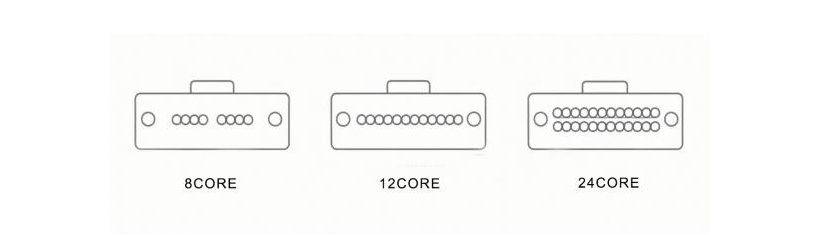
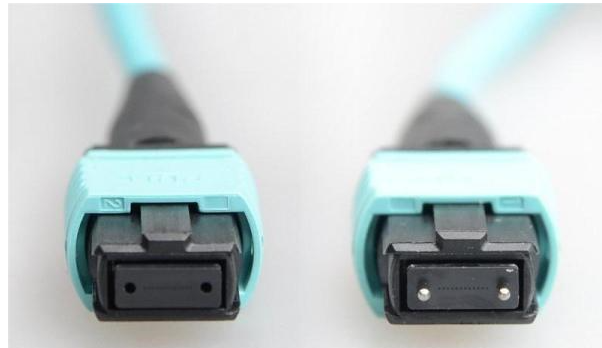
There are two types of MPO/MTP fiber connectors: male and female. The male connector has two PINs, while the female connector has no PINs. The connection between the MPO/MTP fiber connector and the optical module is precisely positioned and connected through PINs. The two connectors that are connected to each other must be one male and one female.
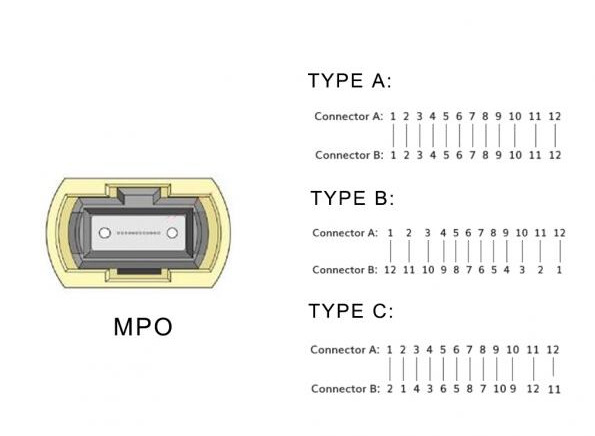
MPO/MTP can be divided into three types according to the corresponding arrangement of the fiber core positions: Type A straight-through type; Type B staggered type; Type C staggered paired type
MPO/MTP fibers can support both single-mode and multimode fibers, but the specific mode depends on the application and the distance the signal needs to be transmitted.
Single-mode MPO/MTP fibers are designed for long-distance transmission. They use a single strand of glass fiber to transmit a single beam of light. Single-mode MPO/MTP fibers can transmit data up to 100 kilometers.
Multimode MPO/MTP fibers are designed for short-distance data transmission. They use multiple paths (modes) to transmit light, which allows them to carry higher data rates than single-mode fibers. However, this also means that the signal will weaken as the distance increases. Multimode MTP/MPO fibers are typically used for short-distance data transmission, such as within a single building or data center.
Single-mode MPO/MTP fibers are designed for long-distance transmission. They use a single strand of glass fiber to transmit a single beam of light. Single-mode MPO/MTP fibers can transmit data up to 100 kilometers.
Multimode MPO/MTP fibers are designed for short-distance data transmission. They use multiple paths (modes) to transmit light, which allows them to carry higher data rates than single-mode fibers. However, this also means that the signal will weaken as the distance increases. Multimode MTP/MPO fibers are typically used for short-distance data transmission, such as within a single building or data center.

4. FAQs about MTP/MPO Fiber
1. Is MTP compatible with MPO?
Yes, MTP (Multi-Fiber Push-On) and MPO (Multi-Fiber Push-On) connectors are generally compatible with each other.
2. Can MTP and MPO fiber cables be used for both single-mode and multi-mode applications?
Yes, MTP (Multi-Fiber Push-On) and MPO (Multi-Fiber Push-On) fiber cables are versatile and can be used for both single-mode and multi-mode applications.
3. Should MTP or MPO fiber be used in high-density cabling systems?
For high-density cabling systems, MTP (Multi-Fiber Push-On) fiber is generally preferred over MPO (Multi-Fiber Push-On) fiber. The main reason is that MTP is a specific type of MPO connector that is designed with higher performance and density in mind.
4. What type of fiber is used with MPO/MTP array connectors?
MPO (Multi-Fiber Push-On) or MTP (Multi-Fiber Push-On) array connectors are generally used with MPO or MTP cables. These connectors are designed for multi-fiber cables and are designed to connect multiple fibers simultaneously in a single compact connector.
1. Is MTP compatible with MPO?
Yes, MTP (Multi-Fiber Push-On) and MPO (Multi-Fiber Push-On) connectors are generally compatible with each other.
2. Can MTP and MPO fiber cables be used for both single-mode and multi-mode applications?
Yes, MTP (Multi-Fiber Push-On) and MPO (Multi-Fiber Push-On) fiber cables are versatile and can be used for both single-mode and multi-mode applications.
3. Should MTP or MPO fiber be used in high-density cabling systems?
For high-density cabling systems, MTP (Multi-Fiber Push-On) fiber is generally preferred over MPO (Multi-Fiber Push-On) fiber. The main reason is that MTP is a specific type of MPO connector that is designed with higher performance and density in mind.
4. What type of fiber is used with MPO/MTP array connectors?
MPO (Multi-Fiber Push-On) or MTP (Multi-Fiber Push-On) array connectors are generally used with MPO or MTP cables. These connectors are designed for multi-fiber cables and are designed to connect multiple fibers simultaneously in a single compact connector.
Unveiling the Brilliance of Optical Communication Bands: Illuminating the Information Superhighway
Excellent Polarization-Maintaining Products, Locking in Stable Optical Signals without Deviation